
Historical COVID-19 archive. Council bulletins, guidance, shared plans and situation reports are collected on this page. This material documents the regional response and may no longer be current. For current standing orders, visit Regional Protocol.
Choose a section or month, then open an entry to read it and access its documents. Council files migrated from the former site are stored in the WordPress Media Library. Historical external resources may have moved or been retired. For unavailable CDC pages, try the CDC Archive.
Browse the archive
- Resource collections
- 2021-03
- 2021-02
- 2021-01
- 2020-12
- 2020-11
- 2020-10
- 2020-09
- 2020-08
- 2020-07
- 2020-06
- 2020-05
- 2020-04
- 2020-03
Resource collections
Former COVID resource directory
Greater Miami Valley EMS Council (GMVEMSC) in conjunction with Dayton MMRS, area public health and emergency management agencies, and the Regional Physicians Advisory Board have created this site to provide resources and information on the COVID-19 outbreak.
Sections
Vaccination
Moderna EUA Fact Sheet for Recipients
Janssen EUA Fact Sheet for Recipients
Just in Time Standing Order (JITSO) for Moderna COVID-19 Vaccine
Just in Time Standing Order (JITSO) for Pfizer COVID-19 Vaccine
Just in Time Standing Order (JITSO) for Janssen COVID-19 Vaccine
Post Vaccination Considerations for EMS Personnel
COVID Vaccination Town Hall – Video
EMS
Law Enforcement
Training
News, Information and Situation Reports
Other Useful Information
Newest Additions:
COVID-19 Early Resource Archive
COVID-19 Resources for Public Safety
Regional News
Public Health has opened a call center that will be staffed Monday to Friday, 8 am to 4 pm. The public may call for general COVID-19 related questions at 937-225-6217.
The call center will not be able to offer personal healthcare advice.
This is in addition to the Ohio Department of Health’s Hotline at 1-833-4-ASK-ODH which is open 7 days a week from 9 am to 8 pm.
Please be advised that Public Health does not diagnose, test or treat Coronavirus COVID-19. If you are feeling sick or have questions about your personal health,
please contact your health care provider or an urgent care provider. Emergency rooms should only be used for immediate life threatening conditions.
Regional Bulletins, & JITSOs
- COVID-19 Bulletin 2: Current Clinical & PPE Issues
- 3/18/20 JITSO
Emergency medical services are a component of critical infrastructure. To protect personnel during the pandemic, the following Just in Time Standing Order (JITSO) is in effect throughout Greater Miami Valley EMS Council immediately.
To ensure effective patient care and minimize cross-contamination of EMS units and hospitals, EMS units will only allow family members or support persons to be transported with the patient when it is essential to patient care. All other requests for companion transports should be denied at this time.
- Examples of companions who must be transported in EMS units include parents or guardians of minors; historians for time-critical diagnoses such as stroke; or translators when significant language barriers exist.
- Companions who are demonstrating infectious symptoms such as fever, cough, illness should not be transported (unless being treated as an additional patient in the patient compartment).
EMS personnel should use aerosol-generating procedures (AGPs) only when they would be life-saving.
- Non-rebreather masks, nebulizer treatments, and CPAP generally are to be avoided in this current outbreak
- Use the patient’s metered dose inhaler (MDI) with a spacer instead of a nebulizer when available. Bring all such equipment to the hospital with the patient.
- Remember that you can place a surgical mask on the patient over oxygen equipment throughout the call.
- When AGPs such as CPR, CPAP, nebulizers, and intubation are needed, if feasible, perform those in an open-air environment, or with vehicle windows open while in transit.
- During transport, vehicle ventilation in both compartments should be on non-recirculated mode to maximize air changes that reduce potentially infectious particles in the vehicle.
- If the vehicle has a rear exhaust fan, use it to draw air away from the cab, toward the patient-care area, and out the back end of the vehicle.
- Remove all aerosolizing devices from the patient just before entering the emergency department. Doing so will help prevent the spread of aerosolized viral particles throughout the ED.
- Always notify the hospital prior to arrival on any suspect COVID-19 case.
During this Pandemic Response, EMS personnel are to approach patients at as distance, determine potential infectious components, assess PPE needs, and have patients don surgical masks from a distance when symptoms present. EMS personnel must conserve PPE and use only as necessary. N-95 masks must be saved for aerosol producing procedures.
PPE conservation must begin now! Tomorrow is too late. There will be much more severe shortages in the future. Surgical masks, gloves, and possibly face shields or goggles are appropriate for most infectious patients. Plan to clean and reuse following CDC guidelines wherever possible. Expect expanded guidance and limitations soon. ALL PPE is coming into shortage, and this will become worse.
Exercise droplet protection when necessary with coveralls or gowns. Uniforms should be laundered frequently during the shift following the transport of potentially contagious patients. Thorough decontamination of the cab and patient compartments should be performed after each transport to protect crews and patients.
Consider using materials such as crash wrap to isolate the driver’s compartment to reduce the need for PPE for drivers.
EMS agencies should consider implementing pre- and post-shift screening for all personnel as recommended in separate emails.
SitReps including from Montgomery County Public Health
- Situation Report – March 18, 2020 (original resource unavailable)
- State EOC SitRep – March 20, 2020
- Dayton FD Tech Unit COVID Stats
- MMWR Week 10 (3.1-3.7)
- Johns Hopkins Map
- COVID-19 Bulletin 3: Planning and Preparedness
- Coronavirus Disease 2019 (COVID-19) in the U.S. https://www.cdc.gov/coronavirus/2019-ncov/cases-in-us.html
- Coronavirus COVID-19 Global Cases by the Center for Systems Science and Engineering (CSSE) at Johns Hopkins University (JHU) https://gisanddata.maps.arcgis.com/apps/opsdashboard/index.html#/bda7594740fd40299423467b48e9ecf6
Info & Guidance for EMS
-
Interim Guidance for Emergency Medical Services (EMS) Systems and 911 Public Safety Answering Points (PSAPs) for COVID-19 in the United States
https://www.cdc.gov/coronavirus/2019-ncov/hcp/guidance-for-ems.html - ODH & OHA Immediate Actions for the Conservation of Personal Protective Equipment
- Release of Stockpiled N95 Filtering Facepiece Respirators Beyond the Manufacturer-Designated Shelf Life: Considerations for the COVID-19 Response https://www.cdc.gov/coronavirus/2019-ncov/release-stockpiled-N95.html
- Recommended Guidance for Extended Use and Limited Reuse of N95 Filtering Facepiece Respirators in Healthcare Settings https://www.cdc.gov/niosh/topics/hcwcontrols/recommendedguidanceextuse.html
- Strategies for Optimizing the Supply of N95 Respirators: Crisis/Alternate Strategies – Crisis/Alternate Strategies https://www.cdc.gov/coronavirus/2019-ncov/hcp/respirators-strategy/crisis-alternate-strategies.html
- APX Radio General Maintenance
- Preparation of High Chlorine Solutions
- 3M Fit Testing
- Fitting Instructions for 3M Respirator
- Make sure to click all the different links!
Below is information on fit-testing. In addition to the materials attached and below, this background information may be useful: https://www.cdc.gov/coronavirus/2019-ncov/hcp/respirator-use-faq.html. We recommend that the person(s) who will conduct the testing read through all of this, including the email, attachments, and links, and watch the videos, then familiarize themselves with the kit.Dayton MMRS has long recommended use of Qualitative Fit Testing (QNFT) for N-95 Respirator Masks procedures (as opposed to Quantitative), in part because quantitative fit testing of disposable N-95 Masks (using equipment such as a PortaCount) is a destructive test, requiring that a hole be punched in the mask. With QNFT, the person can keep the mask for use on a run. With 4,000 EMS personnel in our region, Qualitative fit-testing saves a lot of masks.
Have each person who is fit-tested, use a soft-tipped pen (e.g., a “Sharpie”) to write the person’s name on the mask. They can keep that mask and use it “in the real world” to care for a patient when indicated. Document that the patient received a mask, including make and model. We also continue to recommend use of renewable PPE resources such as PAPRs when possible. Some PAPRs provide a higher protective factor, and PAPRs reduce respiratory work for the wearer.
Also, remind your personnel to place a surgical mask (not an N-95) on the patient.
A short overview on fit-testing and additional information can be found here:
https://www.3m.com/3M/en_US/safety-centers-of-expertise-us/respiratory-protection/fit-testing/
An instructional video on the Quantitative (QNFT) fit test process is here: https://www.youtube.com/watch?v=xl4qX6qEYXU. A “Guide to using the
3M Qualitative Fit Test Kits” is attached, along with fitting instructions.According to OSHA, NIOSH, CDC, and the World Health Organization (WHO), properly fitted and worn N-95 Masks protect against Avian Influenza, SARS, and multiple other agents. Dayton MMRS recommends that partner agencies maintain an appropriate cache of Respiratory PPE. We would like to offer the following recommendations concerning N-95’s:
1) Store and maintain N-95’s according to manufacturer’s recommendations;
2) Annually fit-test personnel who will utilize the N-95’s according to current standards. Employees who are to wear N-95 Masks must be trained and fit-tested, and have an annual respiratory assessment. In one study, investigators found that only 24% (129 of 538) of participants wore the devices properly. N-95’s can legitimately be fit-tested using non-destructive, quantitative tests (i.e., formalized “smell” testing);
3) Ensure that only providers with appropriate training utilize N-95’s;
4) Promulgate an SOP, SOG, or other materials for your organization, requiring appropriate utilization of the N-95’s by your agency’s personnel.
PPE Info & Guidance for Law Enforcement
- ODH & OHA Immediate Actions for the Conservation of Personal Protective Equipment
- Use the fit-testing procedures under PPE for EMS
- What law enforcement personnel need to know about coronavirus disease 2019 (COVID-19) https://www.cdc.gov/coronavirus/2019-ncov/downloads/guidance-law-enforcement.pdf
- Release of Stockpiled N95 Filtering Facepiece Respirators Beyond the Manufacturer-Designated Shelf Life: Considerations for the COVID-19 Response https://www.cdc.gov/coronavirus/2019-ncov/release-stockpiled-N95.html
- Recommended Guidance for Extended Use and Limited Reuse of N95 Filtering Facepiece Respirators in Healthcare Settings https://www.cdc.gov/niosh/topics/hcwcontrols/recommendedguidanceextuse.html
- Strategies for Optimizing the Supply of N95 Respirators: Crisis/Alternate Strategies – Crisis/Alternate Strategies https://www.cdc.gov/coronavirus/2019-ncov/hcp/respirators-strategy/crisis-alternate-strategies.html
Law Enforcement Information & Guidance
- More to come…
Dispatch
- More to come…
CDC Guidance including Cleaning Recommendations, PPE Conservation/Reuse, etc.
- Environmental Cleaning and Disinfection Recommendations https://www.cdc.gov/coronavirus/2019-ncov/community/organizations/cleaning-disinfection.html
Crew Exposure & Quarantine Information
-
The Infection Control Chairs (Chief Chad Follick and Laura Clark, RN) for Greater Miami Valley EMS Council have been asked questions about what happens if an EMS crew suspects they have been exposed to the COVID-19.
- Should the crew pre-notify the ED? The answer to that one is ABSOLUTELY YES, and expect to be directed to a specific entrance.
- Does the crew follow the same exposure procedure that is in place?
- Should they fill out an exposure form?
- Would the hospitals do testing?
- What should we do with that EMS crew while we are waiting for the patient tests to come back?
- If we don’t quarantine them and the patient test positive for COVID-19, have they now “exposed” the entire station?
First , encourage all personnel to follow all of PPE and decontamination procedures appropriate to the patient situation. That will eliminate most exposures.
Crews with an exposure (for example patient without a face mask coughs in the face of a first responder without PPE), the crew should follow the current GMVEMSC Infection Control Policy with regards to reporting these incidents.
- Notify the hospital ASAP when (if) they are transporting a suspected COVID-19 patient and/or if they are transporting a patient with a confirmed case.
- In most scenarios we are suspecting that the patient is infected so we are going to use the Respiratory Exposure (C.) section of policy to guide crews in their reporting procedures.
Crews should:
- Notify the ED charge nurse of the exposure upon delivery of the patient
- Complete the Request for Notification of Test. In these cases being checked in as an ED patient may or may not be necessary.
Upon receipt of the source patient’s diagnosis, follow-up care and prophylaxis may be necessary for those exposed. At this point exposed employees will be notified by the EMS Coordinator and they may have to return to the receiving hospital and be checked in as a patient to receive care. In other situations follow-up care and prophylaxis may come from your department’s workplace health provider or their personal physician.
The decision to quarantine crew members is made by Public Health in your county. Currently Public Health will follow CDC specific quarantine and isolation requirements for individuals exposed to or sick from COVID-19. Regardless, if they are a part of the general population or a first responder the following measures will be followed.
- If a first responder has a known exposure to COVID-19 without proper PPE they should immediately see a physician.
- It should be explained to the physician of the known exposure, to ensure they are placed within an isolation room while gathering a culture if indicated.
- Exposure risk will be evaluated to determine need for testing and quarantine.
- Need for Quarantine will be determined by the local health department.
- With rare exceptions, the crew can remove PPE, perform hygiene, and put on clean uniforms and return to duty while awaiting decisions on quarantine.
- Those crew members are not an immediate risk for transmitting the disease.
- If quarantine does become indicated, that would most likely be in their homes unless an agency makes different arrangements for them..
- Information regarding quarantine would be shared with the first responder from the communicable disease section of Public Health explaining all requirements.
- If a case was severe they would be placed in isolation within the hospital until their condition improved.
Plans Shared by EMS Agencies
- DRAFT documents NOT currently implemented Sidney FD – Screening Memo
- DRAFT documents NOT currently implemented Sidney FD – Screening Assessment
- DRAFT documents NOT currently implemented Sidney FD – Screening Log
- WPAFB FD Response Guidelines
- WPAFB FD Response Plan
- Cincinnati FD COVID Plan
- Xenia COVID-19 Fire Response Guideline
- Xenia COVID-19 Job Aid
Plans Shared by Law Enforcement Agencies
Additional resource directory
EMS
Law Enforcement
Training
News, Information and Situation Reports
Other Useful Information
Guidelines
These entries represent guidelines, policies and procedures created by GMVEMSC and other agencies as part of the COVID-19 response. If your agency has created a COVID-19 response related guideline you’re willing to share to assist other departments, please forward it to the GMVEMSC for inclusion here.
On November …
FROM: James Hodge, Chief, Bureau of Regulatory Operations, Ohio Department of Health
DATE: Oct. 13, 2020
RE: COVID-19 testing of …
All employees must keep six feet between yourself and others as much as possible. Cloth face coverings do not substitute for …
Mask Use by Public Safety Personnel and Others
Based on guidance from the CDC and others, public safety should implement the following:
Anyone who …
Please …
Shared by Major Wendy Stiver, Dayton Police Department.
Agencies can input their own data to help track exposures and …
COVID-19 General Information
Assorted information related to COVID-19
Please …
This partnership offers …
Due to ongoing issues and concerns with the COVID-19 Pandemic Response:
the Quarterly Triage Day (QTD) scheduled for April 21 is being …
If you are coping with behavioral health problems, finding a good mental health clinician is essential to getting help. Finding …
It started as a local Mentor project to address changes in non-transport protocols and to take the …
The National Emergency Medical Services Information System (NEMSIS) has issued guidance to …
Emergency Departments in the region continue to see patients brought in by EMS where patients are not wearing masks. Putting a mask on …
Situation Reports
This section includes state and regional reports related to COVID-19 as well as other relevant reports of interest.
Regional News
On November …
Vaccination is a …
(COLUMBUS, Ohio)—Ohio Governor Mike DeWine announced today that effective on Wednesday, July 8, 2020, at 6:00 …
All Ohio EMS organizations and medical transportation agencies are encouraged to apply
In response to COVID-19 the Ohio …
Please …
This partnership offers …
Due to ongoing issues and concerns with the COVID-19 Pandemic Response:
the Quarterly Triage Day (QTD) scheduled for April 21 is being …
It started as a local Mentor project to address changes in non-transport protocols and to take the …
Bulletins
Emergency Departments in the region continue to see patients brought in by EMS where patients are not wearing masks. Putting a mask on …
Aerosol-generating procedures (AGPs) can be lifesaving. They also present risks to everyone in the vicinity when the patient has a highly contagious …
services are a component of critical infrastructure. To protect
personnel during the pandemic, the following Just in Time Standing Order
(JITSO) is in effect throughout Greater …
Links
Links to additional information
Johns Hopkins Coronavirus Resource Center
Johns Hopkins experts in global public health, infectious disease, and emergency preparedness have been at the forefront of the international response to COVID-19.
Their website is a resource to help advance the understanding of the virus, inform the public, and brief policymakers in order to guide a response, improve care, and save lives.
COVID-19 Testing Site Interactive Map –
The Ohio Department of Health COVID-19 Portal
Public Information Call Center: 937-225-6217 or visit the relevant news entry here for more information on the Call Center.
Coronavirus (COVID-19) Phishing Guidance: visit the information release from KHN for advice on protecting yourself and your company.
Fit Testing PPE: Information on PPE and PPE fit testing on this site and elsewhere. Includes fit testing videos.
WPAFB Chief Jacob King presents PPE Guidance for EMS and Law Enforcement in conjunction with the National Center for Medical Readiness at Calamityville. 0.5 CEUs are available.
What to do if you’re sick from the Coronavirus: A CDC fact sheet for distribution to those affected.
Ohio Department of Public Safety is providing the “Be Part of the Solution” PSA to all EMS agencies and EMS medical directors free of charge and the video can be accessed at https://www.youtube.com/watch?v=xeZw4Jb0ukc&feature=youtu.be
For additional COVID-19 information, explore the ESF-5 Resource Portal and the following highlighted applications:
- Ohio Sentry: COVID-19 Mobile Monitoring
- Ohio Sentry: COVID-19 Hub Site (desktop)
- Watch Office: Dashboard for Display
- Ohio EMA: State EOC Daily Ops Report
Ohio Emergency PPE Maker’s Exchange
(https://repurposingproject.sharetribe.com/) is an available online resource to share and purchase personal protective equipment created through the ingenuity of Ohio manufacturers who have answered the call to help.
OMHAS: Ohio Department of Mental Health and Addiction Services has added a COVID-19 dashboard for first responders to help provide mental health resources in the midst of this crisis response.
ODH Responsible Restart Protocols
2021-03 · 10 entries
20210317 – 0800 State EOC SitRep (2021-03-17)
In the last 24 hours, the Ohio Department of Health reported 1,883 (992,223) total new cases, 10 (7,287) ICU admissions, and 114 (51,756) hospitalizations. The State EOC is currently at Partial Activation as it continues to coordinate response to COVID-19.
While the EOC is available for use by all Emergency Support Functions, ESFs 1, 5, 6, 7, 8, 11, 13, 14, and 15 will remain activated for the ongoing response.
20210315 – 0800 State EOC SitRep (2021-03-15)
In the last 24 hours, the Ohio Department of Health reported 893 (989,191) total new cases, 2 (7,268) ICU admissions, and 35 (51,551) hospitalizations. ODH has temporarily suspended its reporting on COVID-19-related deaths as the department transitions to a more reliable processing system.
The State EOC is currently at Partial Activation as it continues to coordinate response to COVID-19. While the EOC is available for use by all Emergency Support Functions, ESFs 1, 5, 6, 7, 8, 11, 13, 14, and 15 will remain activated for the ongoing response.
DFD Weekly Operations Report 20210314 (2021-03-14)
20210310 – 0800 State EOC SitRep (2021-03-10)
In the last 24 hours, the Ohio Department of Health reported 1,893 (981,618) total new cases, 17 (7,240) ICU admissions, and 132 (51,097) hospitalizations. ODH has temporarily suspended its reporting on COVID-19-related deaths as the department transitions to a more reliable processing system.
The State EOC is currently at Partial Activation as it continues to coordinate response to COVID-19. While the EOC is available for use by all Emergency Support Functions, ESFs 1, 5, 6, 7, 8, 11, 13, 14, and 15 will remain activated for the ongoing response.
20210308 – 0800 State EOC SitRep (2021-03-08)
In the last 24 hours, the Ohio Department of Health reported 735 (978,471) total new cases, 2 (7,207) ICU admissions, and 33 (50,881) hospitalizations. ODH has temporarily suspended its reporting on COVID-19-related deaths as the department transitions to a more reliable processing system.
The State EOC is currently at Partial Activation as it continues to coordinate response to COVID-19. While the EOC is available for use by all Emergency Support Functions, ESFs 1, 5, 6, 7, 8, 11, 13, 14, and 15 will remain activated for the ongoing response.
20210305 – 0800 State EOC SitRep (2021-03-05)
In the last 24 hours, the Ohio Department of Health reported 1,875 (974,480) total new cases, 7 (7,181) ICU admissions, and 82 (50,695) hospitalizations. ODH has temporarily suspended its reporting on COVID-19-related deaths as the department transitions to a more reliable processing system.
The State EOC is currently at Partial Activation as it continues to coordinate response to COVID-19. While the EOC is available for use by all Emergency Support Functions, ESFs 1, 5, 6, 7, 8, 11, 13, 14, and 15 will remain activated for the ongoing response.
20210303 – 0800 State EOC SitRep (2021-03-03)
In the last 24 hours, the Ohio Department of Health reported 1,709 (970,583) total new cases, 12 (7,160) ICU admissions, and 121 (50,503) hospitalizations. ODH has temporarily suspended its reporting on COVID-19-related deaths as the department transitions to a more reliable processing system.
The State EOC is currently at Partial Activation as it continues to coordinate response to COVID-19. While the EOC is available for use by all Emergency Support Functions, ESFs 1, 5, 6, 7, 8, 11, 13, 14, and 15 will remain activated for the ongoing response.
Janssen EUA Fact Sheet for Recipients (2021-03-02)
Attached is the Janssen EUA Fact Sheet for Recipients. Although not essential, it will help you move through the process quickly if you read the Fact Sheet before you arrive to be vaccinated.
As the process moves on, EMS may get one of the three vaccines depending on where you are vaccinated. Make sure you read the correct Fact Sheet. More importantly, remember that your second shot (if required) must be the same “brand” as the first.
And if you are a paramedic or Advanced EMT who is assisting with vaccinations, remember that this is the short fact sheet. Read the JITSO if you’re vaccinating!
Janssen-COVID-19-Vaccine-EUA-Fact-Sheet-for-Recipients-and-Caregivers-2021-02-27
Just in Time Standing Order (JITSO) for Janssen COVID-19 Vaccine (2021-03-02)
Attached is the Greater Miami Valley EMS Council Just in Time Standing Order (JITSO) for Paramedics and Advanced EMTs for Janssen COVID-19 Vaccine. Scope of practice precludes use by EMTs or EMRs. We have made the Janssen JITSO follow the same format as the ones issued for Moderna and Pfizer as closely as possible. All will be available in the GMVEMSC app and on the Council website.
EMS assisting with PODs or Mobile Vaccination Teams may now use Moderna, Pfizer, or Janssen vaccine. Be aware that health departments are now often using different brands in the same Point of Dispensing (POD). Be sure you use the correct JITSO and remember that second doses of Pfizer and Moderna MUST be the same brand as the first. Janssen is a “one and done.”
Region 3 Regional Physicians Advisory Board (RPAB) approved use of EUA Fact Sheet materials for the JITSO. The JITSOs are checklists, derived from the EUA Fact Sheets for Providers. Dr. Marriott and Standing Orders Chairperson Lt. Russell have approved both JITSOs. There are two Emergency Use Authorization (EUA) Fact Sheets for each vaccine: one for providers, and one that vaccine recipients receive. Both EUA Fact Sheets for Janssen are also attached for your information.
Please confirm approval of JITSO use with your Medical Director. At this time, we have been told you do not need to add COVID vaccines to your EMS Drug License. If that changes, we will let you know.
Most if not all LHDs will look to you for assistance at every Point of Dispensing (POD) for COVID vaccines. Make sure your personnel have completed the online training, reviewed the correct JITSO, and reviewed the EMS Standing Order for Anaphylaxis.
Finally, we are working with public health agencies on plans for vaccinations at other locations, including for homebound persons. We’ll keep you up to date on those efforts.
DFD Weekly Operations Report 20210301 (2021-03-01)
2021-02 · 9 entries
20210224 – 0800 State EOC SitRep (2021-02-24)
In the last 24 hours, the Ohio Department of Health reported 2,775 (958,153) total new cases, 29 (7,073) ICU admissions, 94 (16,968) deaths, and 159 (49,651) hospitalizations.
The State EOC is currently at Partial Activation as it continues to coordinate response to COVID-19. While the EOC is available for use by all Emergency Support Functions, ESFs 1, 5, 6, 7, 8, 11, 13, 14, and 15 will remain activated for the ongoing response.
20210219 – 0800 State EOC SitRep (2021-02-19)
In the last 24 hours, the Ohio Department of Health reported 2,282 (947,389) total new cases, 28 (7,002) ICU admissions, 98 (16,611) deaths, and 173 (49,061) hospitalizations.
The State EOC is currently at Partial Activation as it continues to coordinate response to COVID-19. While the EOC is available for use by all Emergency Support Functions, ESFs 1, 5, 6, 7, 8, 11, 13, 14, and
15 will remain activated for the ongoing response.
20210217 – 0800 State EOC SitRep (2021-02-17)
In the last 24 hours, the Ohio Department of Health reported 2,026 (943,291) total new cases, 10 (6,949) ICU admissions, 59 (16,453) deaths, and 104 (48,739) hospitalizations.
The State EOC is currently at Partial Activation as it continues to coordinate response to COVID-19. While the EOC is available for use by all Emergency Support Functions, ESFs 1, 5, 6, 7, 8, 11, 13, 14, and 15 will remain activated for the ongoing response.
DFD Weekly Operations Report 20210215 (2021-02-15)
20210212 – 0800 State EOC SitRep (2021-02-12)
In the last 24 hours, the Ohio Department of Health reported 2,806 (931,437) total new cases, 19 (6,908) ICU admissions, 721 (12,577) deaths, and 189 (48,269) hospitalizations. ODH is currently reconciling COVID-19 deaths, including about 650 in today’s count. This primarily
impacts deaths occurring from November to December 2020.
The State EOC is currently at Partial Activation as it continues to coordinate response to COVID-19. While the EOC is available for use by all Emergency Support Functions, ESFs 1, 5, 6, 7, 8, 11, 13, 14, and
15 will remain activated for the ongoing response.
20210210 – 0800 State EOC SitRep (2021-02-10)
In the last 24 hours, the Ohio Department of Health reported 3,207 (925,350) total new cases, 22 (6,869) ICU admissions, 98 (11,793) deaths, and 181 (47,853) hospitalizations.
The State EOC is currently at Partial Activation as it continues to coordinate response to COVID-19. While the EOC is available for use by all Emergency Support Functions, ESFs 1, 5, 6, 7, 8, 11, 13, 14, and
15 will remain activated for the ongoing response
DFD Weekly Operations Report 20210207 (2021-02-07)
20210205 – 0800 State EOC SitRep (2021-02-05)
In the last 24 hours, the Ohio Department of Health reported 4,120 (910,847) total new cases, 34 (6,800) ICU admissions, 79 (11,509) deaths, and 237 (47,110) hospitalizations.
The State EOC is currently at Partial Activation as it continues to coordinate response to COVID-19. While the EOC is available for use by all Emergency Support Functions, ESFs 1, 5, 6, 7, 8, 11, 13, 14, and
15 will remain activated for the ongoing response.
20210201 – 0800 State EOC SitRep (2021-02-01)
In the last 24 hours, the Ohio Department of Health reported 3,011 (895,792) total new cases, 8 (6,690) ICU admissions, 54 (11,175) deaths, and 80 (46,215) hospitalizations.
The State EOC is currently at Partial Activation as it continues to coordinate response to COVID-19. While the EOC is available for use by all Emergency Support Functions, ESFs 1, 5, 6, 7, 8, 11, 13, 14, and
15 will remain activated for the ongoing response.
2021-01 · 16 entries
DFD Weekly Operations Report 20210131 (2021-01-31)
20210129 – 0800 State EOC SitRep (2021-01-29)
In the last 24 hours, the Ohio Department of Health reported 5,432 (883,716) total new cases, 23 (6,644) ICU admissions, 75 (11,006) deaths, and 256 (45,786) hospitalizations.
The State EOC is currently at Partial Activation as it continues to coordinate response to COVID-19. While the EOC is available for use by all Emergency Support Functions, ESFs 1, 5, 6, 7, 8, 11, 13, 14, and
15 will remain activated for the ongoing response.
20210125 – 0800 State EOC SitRep (2021-01-25)
In the last 24 hours, the Ohio Department of Health reported 4,481 (864,322) total new cases, 14 (6,521) ICU admissions, 31 (10,711) deaths, and 98 (44,783) hospitalizations
The State EOC is currently at Partial Activation as it continues to coordinate response to COVID-19. While the EOC is available for use by all Emergency Support Functions, ESFs 1, 5, 6, 7, 8, 11, 13, 14, and 15 will remain activated for the ongoing response.
20210118 – 0800 State EOC SitRep (2021-01-18)
In the last 24 hours, the Ohio Department of Health reported 5,247 (826,754) total new cases, 10 (6,355) ICU admissions, 65 (10,200) deaths, and 141 (43,189) hospitalizations.
The State EOC is currently at Partial Activation as it continues to coordinate response to COVID-19. While the EOC is available for use by all Emergency Support Functions, ESFs 1, 5, 6, 7, 8, 11, 13, 14, and
15 will remain activated for the ongoing response.
DFD Weekly Operations Report 20210117 (2021-01-17)
Just in Time Standing Order (JITSO) for Pfizer COVID-19 Vaccine (2021-01-16)
Attached is the Greater Miami Valley EMS Council Just in Time Standing Order (JITSO) for Paramedics and Advanced EMTs for Pfizer COVID-19 Vaccine. Since this is an IM injection, scope of practice precludes use by EMTs or EMRs.
EMS assisting with PODs or Mobile Vaccination Teams may now use either Moderna or Pfizer vaccine. Health departments generally try to use only one on a given day (for example, the Montgomery County POD on January 19th will use only Moderna vaccine and the one on the 20th will use only Pfizer), but that may change as things progress. Be sure you use the correct JITSO, and remember that second doses MUST be the same brand as the first.
We have made the Pfizer JITSO follow the same format as the one for Moderna as closely as possible. For your convenience, both the Pfizer and Moderna JITSOs are attached.
Region 3 Regional Physicians Advisory Board (RPAB) approved use of EUA Fact Sheet materials for the JITSO. The JITSOs are checklists, derived from the Pfizer and Moderna EUA Fact Sheets for Providers. Dr. Marriott and Standing Orders Chairperson Lt. Russell have approved both JITSOs. There are two Emergency Use Authorization (EUA) Fact Sheets for each vaccine: one for providers, and one that every vaccine recipient receives. All four EUA Fact Sheets are also attached for your information.
Please confirm approval of JITSO use with your Medical Director. At this time, we have been told you do not need to add COVID vaccines to your EMS Drug License. If that changes, we will let you know.
Most if not all LHDs will look to you for assistance at every Point of Dispensing (POD) for COVID vaccines. Make sure your personnel have completed the online training, reviewed the correct JITSO, and reviewed the EMS Standing Order for Anaphylaxis
20210115 – 0800 State EOC SitRep (2021-01-15)
In the last 24 hours, the Ohio Department of Health reported 7,654 (807,293) total new cases, 37 (6,289) ICU admissions, 109 (9,990) deaths, and 340 (42,491) hospitalizations.
The State EOC is currently at Partial Activation as it continues to coordinate response to COVID-19. While the EOC is available for use by all Emergency Support Functions, ESFs 1, 5, 6, 7, 8, 11, 13, 14, and 15 will remain activated for the ongoing response.
20210113 – 0800 State EOC SitRep (2021-01-13)
In the last 24 hours, the Ohio Department of Health reported 7,981 (792,938) total new cases, 49 (6,237) ICU admissions, 100 (9,802) deaths, and 486 (41,863) hospitalizations.
The State EOC is currently at Partial Activation as it continues to coordinate response to COVID-19. While the EOC is available for use by all Emergency Support Functions, ESFs 1, 5, 6, 7, 8, 11, 13, 14, and
15 will remain activated for the ongoing response.
20210111 – 0800 State EOC SitRep (2021-01-11)
In the last 24 hours, the Ohio Department of Health reported 6,088 (777,065) total new cases, 12 (6,160) ICU admissions, 28 (9,627) deaths, and 101 (41,158) hospitalizations.
The next PPE push, which will consist of gloves and three-ply surgical masks is scheduled for January 11 and 13th, 2021.
The State EOC is currently at Partial Activation as it continues to coordinate response to COVID-19. While the EOC is available for use by all Emergency Support Functions, ESFs 1, 5, 6, 7, 8, 11, 13, 14, and 15 will remain activated for the ongoing response.
DFD Weekly Operations Report 20210111 (2021-01-11)
COVID-19 Vaccination Training for EMS Personnel (2021-01-10)
This training covers use of Influenza and COVID vaccines. Because most of those vaccines are administered by IM injections, the training is primarily for AEMTs and Paramedics in the GMVEMSC region. To obtain Continuing Education credit from GMVEMSC for this training, complete the following components:
1. Watch the Dayton MMRS/GMVEMSC Video, “Vaccinations by EMS Providers”
2. Watch two additional short videos:
- What’s in a COVID Vaccine Box” at https://www.msn.com/en-us/video/peopleandplaces/what-s-inside-an-operation-warp-speed-vaccine-distribution-box/vi-BB1bdqqt?ocid=spartan-ntp-feeds
- IM Injection Sites at https://www.youtube.com/watch?v=PqSuCPnPeYE
3. When you have reviewed the materials above, click here to take the post-test and receive continuing education (CE) credit.
Additional resources available for you:
- Two sample standing orders for influenza vaccine such as those often used by public health can be viewed here:
- Standing Orders for Administering Influenza Vaccine to Children and Teens: https://www.immunize.org/catg.d/p3074a.pdf
- Standing Orders for Administering Influenza Vaccine to Adults: https://www.immunize.org/catg.d/p3074.pdf
- PDF handout of the PowerPoint presentation
- Download of the PowerPoint is presentation
- Link for the “Vaccinations by EMS Providers” video presentation
- An optional Skills Checklist is here: https://www.immunize.org/catg.d/p7010.pdf
- The link to the CDC Pink Book referenced in the video is here: https://www.cdc.gov/vaccines/pubs/pinkboo k/flu.html
- IAFC White Paper on Dry Ice
Combating Vaccine Hesitancy (2021-01-10)
Are you or someone you know hesitant about getting the COVID vaccine? Check out these resources on combatting vaccine hesitancy:
IAEMSC-Position-Paper-VACCINE-PRIORITY-2020
NAEMSP Statement on Prioritizing EMS Professionals’ Access to COVID-19 Vaccine
COVID Vaccine Town Hall (2021-01-10)
Paramedics and EMTs across the country have contracted COVID-19, and too many have succumbed to the Virus. NAEMT has assembled some of our nation’s most notable EMS physician leaders for a virtual town hall to answer your questions and concerns regarding the COVID vaccines. The discussion was led primarily by questions EMS asked.
20210106 – 0800 State EOC SitRep (2021-01-06)
In the last 24 hours, the Ohio Department of Health reported 7,580 (735,003) total new cases, 44 (6,022) ICU admissions, 104 (9,247) deaths, and 538 (39,650) hospitalizations.
The next PPE push, which will consist of gloves and three-ply surgical masks is scheduled for January 11 and 13th, 2021.
The State EOC is currently at Partial Activation as it continues to coordinate response to COVID-19. While the EOC is available for use by all Emergency Support Functions, ESFs 1, 5, 6, 7, 8, 11, 13, 14, and 15 will remain activated for the ongoing response.
20210104 – 0800 State EOC SitRep (2021-01-04)
In the last 24 hours, the Ohio Department of Health reported 6,808 (721,481) total new cases, 23 (5,933) ICU admissions, 59 (9,076) deaths, and 165 (38,798) hospitalizations.
The next PPE push, which will consiste of gloves and three-ply surgical masks is scheduled for January 11 and 13th, 2021.
The State EOC is currently at Partial Activation as it continues to coordinate response to COVID-19. While the EOC is available for use by all Emergency Support Functions, ESFs 1, 5, 6, 7, 8, 11, 13, 14, and 15 will remain activated for the ongoing response.
DFD Weekly Operations Report 20210104 (2021-01-04)
2020-12 · 12 entries
20201230 – 0800 State EOC SitRep (2020-12-30)
In the last 24 hours, the Ohio Department of Health reported 7,526 (682,570) total new cases, 52 (5,801) ICU admissions, 151 (8,722) deaths, and 560 (37,636) hospitalizations.
The next PPE push, which will consiste of gloves and three-ply surgical masks is scheduled for January 11 and 13th, 2021.
The State EOC is currently at Partial Activation as it continues to coordinate response to COVID-19. While the EOC is available for use by all Emergency Support Functions, ESFs 1, 5, 6, 7, 8, 11, 13, 14, and 15 will remain activated for the ongoing response.
20201228 – 0800 State EOC SitRep (2020-12-28)
In the last 24 hours, the Ohio Department of Health reported 5,857 (670,525) total new cases, 30 (5,719) ICU admissions, 33 (8,509) deaths, and 273 (36,786) hospitalizations.
The State EOC is currently at Partial Activation as it continues to coordinate response to COVID-19. While the EOC is available for use by all Emergency Support Functions, ESFs 1, 5, 6, 7, 8, 11, 13, 14, and 15 will remain activated for the ongoing response.
DFD Weekly Operations Report 20201227 (2020-12-27)
20201223 – 0800 State EOC SitRep (2020-12-25)
In the last 24 hours, the Ohio Department of Health reported 7,678 (637,032) total new cases, 51 (5,588) ICU admissions, 130 (8,252) deaths, and 546 (35,594) hospitalizations.
The State EOC is currently at Partial Activation as it continues to coordinate response to COVID-19. While the EOC is available for use by all Emergency Support Functions, ESFs 1, 5, 6, 7, 8, 11, 13, 14, and 15 will remain activated for the ongoing response.
Just in Time Standing Order (JITSO) for Moderna COVID-19 Vaccine (2020-12-25)
Attached is the Greater Miami Valley EMS Council Just in Time Standing Order (JITSO) for Paramedics and Advanced EMTs for Moderna COVID-19 Vaccine. Since this is an IM injection, scope of practice precludes use by EMTs or EMRs.
Region 3 Regional Physicians Advisory Board (RPAB) approved use of EUA Fact Sheet materials for the JITSO. The JITSO is a checklist, derived from the Moderna EUA Fact Sheet for Providers. Dr. Marriott has approved this JITSO. There are two Emergency Use Authorization (EUA) Fact Sheets for each vaccine: one for providers, and one that every vaccine recipient receives. Both are attached for your information.
Please confirm approval of JITSO use with your Medical Director. At this time, we have been told you do not need to add Moderna vaccine to your EMS Drug License. If that changes, we will let you know.
Additional information:
- Local Health Departments (LHDs) throughout our region are receiving Moderna vaccine this week. Some of that is earmarked for EMS.
- In addition to providing vaccine to EMS personnel, most if not all LHDs will look to you for assistance at every Point of Dispensing (POD) for COVID vaccines. Make sure your personnel have completed the online training and reviewed the JITSO and the EMS Standing Order for Anaphylaxis
- This JITSO is specific to Moderna vaccine. At this point in Ohio, Pfizer COVID vaccine is largely being administered to specific populations by two large pharmacy chains. As more of the Pfizer vaccine becomes available, we will issue an additional JITSO.
Moderna EUA Fact Sheet for Recipients (2020-12-25)
Attached is the Moderna EUA Fact Sheet for Recipients. Most EMS personnel being vaccinated in our region over the next few weeks will receive the Moderna Vaccine. Although not essential, it will help you move through the process quickly if you read the Fact Sheet before you arrive to be vaccinated.
As the process moves on, EMS may get either the Moderna or Pfizer vaccine depending on where you are vaccinated. Make sure you read the correct Fact Sheet. More importantly, remember that your second shot must be the same “brand” as the first.
And if you are a paramedic or Advanced EMT who is assisting with vaccinations, remember that this is the short fact sheet. Read the JITSO if you’re vaccinating!
Post Vaccination Considerations for EMS Personnel (2020-12-25)
The following information is provided for Fire and EMS agencies following COVID immunization of personnel, regarding isolation of personnel for symptoms of COVID as opposed to side effects of COVID vaccinations. This document is intended to reduce the risks for disruptions in work resulting from:
- Unnecessarily excluding personnel with only post-vaccination signs and symptoms from work, and
- Inadvertently allowing personnel with COVID infection to work.
Considerations are based on the current information, including timing and duration, and may change as experience with the vaccine accumulates.
Overview
Systemic signs and symptoms such as fever, fatigue, headache, chills, muscle and joint aches can occur following COVID-19 vaccination. Preliminary information from COVID-19 vaccine trials indicates that most post-vaccination signs and symptoms are mild to moderate in severity, occur within the first three days of vaccination (the day of vaccination and following two days, with most occurring the day after vaccination), resolve within 1-2 days of onset, and are more frequent and severe following the second dose and among younger persons compared to those who are older (>55 years). Cough, shortness of breath, congestion/runny nose, sore throat, or loss of taste or smell are NOT consistent with post-vaccination symptoms, and instead may be symptoms of COVID-19 or another infection.
If EMS personnel with postvaccination signs and symptoms are restricted from work unnecessarily, this has negative consequences for the personnel, the agency, and the community. Note that vaccinated personnel should continue to follow all current infection prevention and control recommendations to protect themselves and others from COVID-19 infection.
Strategies to Reduce Lost Work Time due to Post Vaccination COVID Symptoms:
- Vaccinate personnel when they are not required to be at work for the next 1-2 days when feasible.
- Stagger delivery of vaccine so that not all personnel from a shift are vaccinated at the same time. Staggering vaccinations may be more important following the second dose of vaccine.
- Inform personnel about potential vaccine side effects, mitigation (e.g., nonsteroidal anti-inflammatory medications or acetaminophen), and agency polices.
Suggested Approaches to Evaluating and Managing Post-Vaccination Side Effects
The approaches below apply to personnel who have received the COVID-19 vaccination in the prior 3 days (including day of vaccination, which is considered day 1) and are not known to have had unprotected exposure to COVID-19 in the previous 14 days. Symptomatic personnel who are within 14 days of an unprotected exposure should be isolated.
Ultimately, clinical judgement should be used to determine the likelihood of infection versus post-vaccination symptoms and the indicated clinical approach.
NOTE: A positive (nucleic acid or antigen) COVID test should NOT be attributed to the COVID-19 vaccine. The vaccination does not influence the results of these tests.
The following signs and symptoms, alone, are not consistent with COVID-19 infection:
- Immediate hypersensitivity reactions (e.g., urticaria, anaphylaxis)
- Local symptoms (e.g., pain, swelling, or redness at injection site)
Signs and symptoms unlikely to be from COVID-19 vaccination:
Cough, shortness of breath, rhinorrhea (runny nose/congestion), sore throat, or loss of taste or smell) are not typical post-vaccination signs and symptoms. Agency policy for potential COVID infection should be applied for testing and isolation, including exclusion from work.
Signs and symptoms that may be from either COVID-19 vaccination or COVID-19 infection:
Systemic signs and symptoms (e.g., fever of 100.0 F or greater, fatigue, headache, chills, muscle and body aches) are consistent with post-vaccination signs and symptoms as well as with COVID-19.
Evaluate personnel who have the following criteria. They may be considered for return to work without viral testing for COVID-19:
- Feel well enough and are willing to work and
- Signs and symptoms are limited only to those observed following COVID-19 vaccination (i.e., do not have other signs and symptoms of COVID-19 including cough, shortness of breath, sore throat, or change in smell or taste).
- If personnel remain symptomatic for more than 2 days, agency policy should be followed for potential COVID infection, including isolation and exclusion from work.
- Ideally personnel with fever should be excluded from work pending further evaluation, including consideration for SARS-CoV-2 testing. If an infectious etiology is not suspected or confirmed as the source of their fever, they may return to work when they feel well enough.
- In agencies with critical staffing shortages, personnel with fever and systemic signs and symptoms limited only to those observed following vaccination could be considered for work if they feel well enough and are willing. They should be re-evaluated, and viral testing for SARS-CoV-2 considered, if fever does not resolve within 2 days.
Information derived from CDC Guidance. Full guidance is available here:
https://www.cdc.gov/coronavirus/2019-ncov/hcp/post-vaccine-considerations-healthcare-personnel.html
EMS Medical Directors vaccinated by Paramedics (2020-12-24)
Today Public Health began vaccinations of local EMS workers and Home Care workers at the Dayton Convention Center. The vaccination clinic was not open to the public. Included here is video featuring the Dayton Fire Department getting vaccinated and Dr. Randy Marriott, Medical Director of the Dayton Fire Department and Dayton MMRS. As well as, Dr. James E. Brown MD Associate Medical Director, Dayton Fire Department and Dayton MMRS. (The sound for Dr. Marriott is at the end of his clip)
Public Health received 3,100 doses of the Moderna vaccine this week and is using it to begin the vaccination process for EMS workers and Home Care workers.
Dr. Randy Marriott
Dr. James Brown MD
Additional Video
20201221 – 0800 State EOC SitRep (2020-12-21)
In the last 24 hours, the Ohio Department of Health reported 8,377 (622,806) total new cases, 17 (5,550) ICU admissions, 16 (8,047) deaths, and 194 (34,747) hospitalizations.
The State EOC is currently at Partial Activation as it continues to coordinate response to COVID-19. While the EOC is available for use by all Emergency Support Functions, ESFs 1, 5, 6, 7, 8, 11, 13, 14, and 15 will remain activated for the ongoing response.
DFD Weekly Operations Report 20201108 (2020-12-21)
20201218 – 0800 State EOC SitRep (2020-12-18)
In the last 24 hours, the Ohio Department of Health reported 11,412 (596,178) total new cases, 38 (5,382) ICU admissions, 117 (7,894) deaths, and 370 (33,745) hospitalizations.
The State EOC is currently at Partial Activation as it continues to coordinate response to COVID-19. While the EOC is available for use by all Emergency Support Functions, ESFs 1, 5, 6, 7, 8, 11, 13, 14, and
15 will remain activated for the ongoing response.
PHDMC Case Report and Map – 20201214 (2020-12-14)
The following case report and maps has been provided by the Department of Public Health for Dayton and Montgomery County and are current as of December 14, 2020.
2020-11 · 14 entries
20201130 – 0800 State EOC SitRep (2020-11-30)
In the last 24 hours, the Ohio Department of Health reported 7,729 (414,432) total new cases, 36 (4,644) ICU admissions, 21 (6,399) deaths, and 245 (26,507) hospitalizations.
The State EOC is currently at Partial Activation as it continues to coordinate response to COVID-19. While the EOC is available for use by all Emergency Support Functions, ESFs 1, 5, 6, 7, 8, 11, 13, 14, and 15 will remain activated for the ongoing response.
PHDMC SitRep 20201124 (2020-11-30)
Public Health – Dayton & Montgomery County, the Ohio Department of Health (ODH) Centers for Disease Control and Prevention (CDC) and World Health Organization (WHO) continued to respond to the COVID-19 Pandemic.
20201127 – 0800 State EOC SitRep (2020-11-27)
AS of November 25, the Ohio Department of Health reported 10,835 (382,743) total new cases, 44 (4,527) ICU admissions, 156 (6,274) deaths, and 417 (25,486) hospitalizations.
The State EOC is currently at Partial Activation as it continues to coordinate response to COVID-19. While the EOC is available for use by all Emergency Support Functions, ESFs 1, 5, 6, 7, 8, 11, 13, 14, and 15 will remain activated for the ongoing response.
20201125 – 0800 State EOC SitRep (2020-11-25)
Over the past 24 hours, the Ohio Department of Health reported 8,604 (371,908) total new cases, 29 (4,483) ICU admissions, 98 (6,118) deaths, and 364 (25,069) hospitalizations.
The State EOC is currently at Partial Activation as it continues to coordinate response to COVID-19. While the EOC is available for use by all Emergency Support Functions, ESFs 1, 5, 6, 7, 8, 11, 13, 14, and 15 will remain activated for the ongoing response.
COVID-19 Contingency Measures for Ohio EMS (2020-11-25)
| To: | Ohio EMS providers, EMS agencies, and EMS medical directors |
| From: | Carol A. Cunningham, M.D., FAAEM, FAEMS |
| State Medical Director | |
| Date: | November 25, 2020 |
| RE: | Legislated COVID-19 Contingency Measures for Ohio EMS |
On November 23, 2020, Governor DeWine signed House Bill 151 into law.
As most of you are aware, healthcare facilities, including hospitals, are currently facing impactful manpower shortages due to the significant increase in patient hospitalizations paired with healthcare providers who are unable to work due to infection with or exposure to the COVID-19 virus. Previously, emergency medical technicians, advanced emergency medical technicians, and paramedics functioning within a hospital setting were limited to the emergency department and to transport of patients from the emergency department to other areas within the hospital. During this critical time of need, there is a need for assistance from all available certified Ohio EMS providers. House Bill 151 now permits emergency medical responders, emergency medical technicians, advanced emergency medical technicians, and paramedics to perform emergency medical services in any setting, including in any area of a hospital, if the services are performed under the direction and supervision of one of the following:
- A physician
- A physician assistant designated by a physician
- An advanced practice registered nurse designated by a physician
House Bill 151 also provides liability protection to Ohio EMS providers functioning in this role. Specifically, an emergency medical responder, emergency medical technician, advanced emergency medical technician, and paramedic is not liable in damages in a civil action for injury, death, or loss to person or property resulting from the individual’s administration of emergency medical services, unless the services are administered in a manner that constitutes willful or wanton misconduct.
House Bill 151 will remain in effect until July 1, 2021.
Typically, EMS medical directors and most emergency physicians are well versed in the parameters within the Ohio EMS scope of practice. However, this may not be the case with other healthcare providers or physicians who specialize in other medical specialties. Each Ohio EMS provider is responsible for their individual Ohio EMS certification and to ensure that their actions are within the authorized Ohio EMS scope of practice for their respective level of certification. If any healthcare provider requests the provision of emergency medical services that are beyond the Ohio EMS scope of practice, it is the responsibility of the Ohio EMS provider to decline to perform skills or provide services that are not authorized by the State Board of Emergency Medical, Fire, and Transportation Services. The emergency medical services that have been authorized by the State Board of Emergency Medical, Fire, and Transportation Services are cited in the Ohio Administrative Code (OAC) as follows:
- Emergency medical responder: OAC 4765-12-04
http://codes.ohio.gov/oac/4765-12
- Emergency medical technician: OAC 4765-15-04
http://codes.ohio.gov/oac/4765-15-04v1
- Advanced emergency medical technician: OAC 4765-16-04
https://codes.ohio.gov/oac/4765-16-04
- Paramedic: OAC 4765-17-03
http://codes.ohio.gov/oac/4765-17-03
Once again, thank you for your dedicated service to the residents and visitors of the State of Ohio. The value of EMS as a critical member of our emergency response networks and healthcare systems cannot be overstated, not just during this pandemic, but for each and every day.
20201113 – 0800 State EOC SitRep (2020-11-13)
Over the past 24 hours, the Ohio Department of Health reported 7,101 (274,457) total new cases, 21 (4,143) ICU admissions, 35 (5,658) deaths, and 268 (21,558) hospitalizations.
The State EOC is currently at Partial Activation as it continues to coordinate response to COVID-19. While the EOC is available for use by all Emergency Support Functions, ESFs 1, 5, 6, 7, 8, 11, 13, 14, and
15 will remain activated for the ongoing response.
PHDMC SitRep 20201111 (2020-11-11)
Public Health – Dayton & Montgomery County, the Ohio Department of Health (ODH) Centers for Disease Control and Prevention (CDC) and World Health Organization (WHO) continued to respond to the COVID-19 Pandemic.
20201111 – 0800 State EOC SitRep (2020-11-11)
Over the past 24 hours, the Ohio Department of Health reported 6,508 (261,482) total new cases, 39 (4,086) ICU admissions, 23 (5,547) deaths, and 386 (21,037) hospitalizations.
The State EOC is currently at Partial Activation as it continues to coordinate response to COVID-19. While the EOC is available for use by all Emergency Support Functions, ESFs 1, 5, 6, 7, 8, 11, 13, 14, and
15 will remain activated for the ongoing response.
PHDMC SitRep 20201028 (2020-11-09)
Public Health – Dayton & Montgomery County, the Ohio Department of Health (ODH) Centers for Disease Control and Prevention (CDC) and World Health Organization (WHO) continued to respond to the COVID-19 Pandemic.
20201109 – 0800 State EOC SitRep (2020-11-09)
DFD Weekly Operations Report 20201108 (2020-11-08)
First, for some good news (much needed). Pfizer announced today that initial analysis of its vaccine which is currently in its Phase 3 trials may be showing an estimated 90% efficacy. Though they have not yet completed their analysis, they anticipate reaching their desired threshold of cases soon and plan on petitioning for emergency use authorization by the FDA as soon as two months have passed since their first test subjects are two months post-vaccination. This could mean they are able to apply for authorization around Thanksgiving.
Some additional good news, though cases are skyrocketing at the Local, State, and National level, deaths have not yet began to spike significantly. Though they are again averaging approximately 1,000/day nationally, they are well below the 2,000-3,000 seen daily in late April/early May and are still trending slightly lower than the second wave in August. That being said, this news must be viewed with some caution as the average elapsed time from infection to death ranges from 2-3 weeks, and as such should the accelerated growth we are currently see continue, we can anticipate mortality too as well especially as medical resources begin to become strained.
On the topic of case growth, the daily case growth rates continue to rise significantly.
Dayton/Montgomery County 1.51% (10/26 – 11/2)
Ohio 1.40% (10/26 – 11/2)
United States 1.04% (11/3 – 11/8)
Should these trends continue, and not be mitigated by some external factors such as effective vaccination or new/reestablished social distancing policies from a Local, State, or National level, it is not a matter “If” but rather “When” the healthcare infrastructure begins to show signs of significant strain. Take the below example:
Should Dayton/Montgomery County remain at a 1.25% daily case growth rate
By the end of February we could see a total of roughly 49,000 cases in the region
With a 1.00% observed mortality rate (1.39% currently in the region) that would mean roughly 490 deaths in Dayton/Montgomery County (we are currently at 193)
If just 20% of them were “active” on that day, that would mean 9,800 active cases in the region on a single day
If just 10% of those “active” cases required hospitalization, that would be 980 COVID-19 patients hospitalized in the region
If just 20% of hospitalized cases require ICU care, that would mean 196 ICU beds in the region being utilized for COVID-19 patients
Couple this data with the typical need for ICU capacity during the peak influenza season and area hospitals will very likely be in serious trouble.
20201102 – 0800 State EOC SitRep (2020-11-02)
Over the past 24 hours, the Ohio Department of Health reported 3,303 (219,000) total new cases, 17 (3,876) ICU admissions, 2 (5,303) deaths, and 88 (19,220) hospitalizations.
The State EOC is currently at Partial Activation as it continues to coordinate response to COVID-19. While the EOC is available for use by all Emergency Support Functions, ESFs 1, 5, 6, 7, 8, 11, 13, 14, and
15 will remain activated for the ongoing response.
PHDMC Case Report and Map – 20201102 (2020-11-02)
The following case report and maps has been provided by the Department of Public Health for Dayton and Montgomery County and are current as of November 2, 2020.
COVID_19-Cases_Ohio_WCO_MC_EpiCurve_11.2.20
DFD Weekly Operations Report 20201101 (2020-11-01)
COVID-19 cases continue to rise rapidly at the Dayton/Montgomery County, State, and National levels. As such, all three have recorded their single highest daily case counts this past week (10/26-11/1).
In addition, the State of Ohio (to include Dayton/Montgomery County) currently estimates that approximately 20% of its recorded cases YTD can be considered “ACTIVE” at this time (and therefore capable of spread). This data would indicate the likelihood of ongoing increased daily case counts which could very quickly create a situation in which local cases requiring hospitalization outpace regional resources.
Later this week I hope to release an updated forecast for regional case grow potentials using the increasing daily case growth rates.
2020-10 · 4 entries
20201028 – 0800 State EOC SitRep (2020-10-28)
Over the past 24 hours, the Ohio Department of Health reported 2,509 (202,740) total new cases, 20 (3,771) ICU admissions, 22 (5,239) deaths, and 198 (18,433) hospitalizations.
The State EOC is currently at Partial Activation as it continues to coordinate response to COVID-19. While the EOC is available for use by all Emergency Support Functions, ESFs 1, 5, 6, 7, 8, 11, 13, 14, and
15 will remain activated for the ongoing response.
The 26th push of PPE to primary county drop sites in each county will be conducted on Wednesday, October 28.
DFD Weekly Operations Report 20201025 (2020-10-25)
National, state, and local case continue to surge at an increasing rate. As such, heightened caution, reevaluation of mitigation tactics, and a review alternate operating procedures are likely warranted.
In addition, from this point forward this report will also include a breakdown of City and County known cases within the school communities.
Data through 10/25/2020 shows the following:
· The daily average EMS call volume is running 3.34% below the average for October of 2019, averaging 80.07 EMS calls per day versus 82.84 in 2019
· Potential call types are on the rise, and for the week of 10/19/2020 thru 10/25/2020 and crews encountered 9 known +COVID-19 patients
· Non-traumatic, non-transported field terminations are averaging 1.23/day, this is 0.16/day less than October of last year (1.39/day), this is a decrease of 11.51%
DAYTON/MONTGOMERY COUNTY
· Confirmed cases in Dayton/Montgomery County have grown from 10,282 on 10/18 to 10,864 on 10/18, this is an increase of 582 (5.66%)
· The week of 10/5/2020 thru 10/11/2020 saw an average case growth rate of 1.19%, the week of 10/12/2020 thru 10/18/2020 saw a 1.13% daily average, thus Dayton/Montgomery County is trending DOWN (Slightly) so far as case growth rate (Most recent week omitted due to reporting lag)
· Deaths in Dayton/Montgomery County have stayed at 189 for the week of 10/18 thru 10/25. Bringing observed mortality in the region to 1.74%
· Our current case incidence of the population is at 2.04%
· Schools Student (New) Student (Cumulative) Staff (New) Staff (Cumulative)
o Dayton (Online Only) 0 0 4 11
o Montgomery County (Mixed) 13 71 28 67
OHIO
· Confirmed cases in Ohio have grown from 188,916 on 10/18 to 198,115 on 10/25, this is an increase of 9,199 (4.87%)
· The week of 10/5/2020 thru 10/11/2020 saw an average case growth rate of 0.94%, the week of 10/12/2020 thru 10/18/2020 saw a 0.98% daily average, thus Ohio is trending UP so far as case growth rate (Most recent week omitted due to reporting lag)
· Deaths in Ohio have grown from 5,179 on 10/18 to 5,206 on 10/25, this is an increase of 27 (0.52%). Bringing observed mortality in the State to 2.63%
· The State’s case incidence is at 1.69% of the population
UNITED STATES
· Confirmed case in the U.S. have grown from 8,081,489 on 10/18 to 8,553,827 on 10/25, this is an increase of 472,338 (5.84%)
· The past seven days have seen an average case growth rate of 0.81%, the previous week saw a 0.70% daily average, thus the United States is trending UP so far as daily case growth rates
· Deaths in the U.S. have grown from 218,511 on 10/18 to 224,221 on 10/25, this is an increase of 5,710 (2.61%). Bringing observed mortality in the U.S. to 2.62%
· The National case incidence is at 2.61% of the population
COVID-19 testing of personnel providing non-urgent medical transportation (2020-10-13)
TO: Ohio medical transportation providers
FROM: James Hodge, Chief, Bureau of Regulatory Operations, Ohio Department of Health
DATE: Oct. 13, 2020
RE: COVID-19 testing of personnel providing non-urgent medical transportation for nursing home residents
As part of ongoing efforts to minimize the transmission of COVID-19 among Ohio’s vulnerable nursing home residents, personnel providing non-urgent medical transportation to this population should be tested for the virus. Examples of non-urgent medical transportation are ambulettes and non-emergent emergency medical services (EMS) transports.
Personnel providing such services should be tested by the nursing facility or provide documentation that required testing was completed during the timeframe that corresponds to the facility’s testing frequency.
This is in accordance with a Centers for Medicare & Medicaid Services (CMS) Interim Final Rule (CMS-3401-IFC), included in QSO-20-38-NH, dated Aug. 26, 2020, which provides that personnel providing services under arrangement to nursing home residents are to be tested.
Affected personnel should work with appropriate facilities and local health departments to determine specific testing requirements to comply with this CMS directive.
Individuals providing emergency services, such as EMS workers or law enforcement officers, are not required to undergo testing or show proof of testing, and they should not be delayed in responding to emergency situations.
Additional questions concerning COVID-19 testing requirements should be referred to the Ohio Department of Health Bureau of Regulatory Operations at (614) 644-6220.
Nitrile Gloves – Significant Supply Chain Issues (2020-10-11)
Nationwide/worldwide shortages of nitrile gloves are becoming increasingly severe. Worse is that the larger sizes (worn by many public safety personnel) are often the least available. Costs are increasing and purchase quantities are limited.
Worse still are seller issues, from outright scams to selling bad or wrong product, such as gloves that have been sitting in storage for many years (sometimes in storage conditions that would be inappropriate even for the short term), to false labeling/advertising (e.g., labeling latex gloves as nitrile, wrong sizes, many other variations). Many of the gloves available even from reputable dealers are not certified to NFPA standards, and the performance standards they meet (29 CFR Parts 170-199) are for food service, not blood borne pathogens (29 CFR 1910.1030).
We suggest that all public safety agencies consider the following:
- Purchase what you can now from reliable suppliers, understanding that product may not ship for many months.
- Explore and purchase cheap gloves that can be worn in appropriate circumstances when there is not a need for the highest-level protection. Such gloves could be worn for “house duties” and other situations.
- Avoid purchasing “non-patient care” type gloves that could be easily confused with current EMS stock. This is becoming more difficult as glove color choices are limited and there may be no clear way to discern which are NFPA compliant medical exam gloves and which are not.
- Consider the purchase of reusable “utility” type gloves for all personnel for routine work around the station, cleaning, etc.
- Provide guidance for personnel on which gloves should be worn in various situations
- Use extreme caution in your purchase processes
- Share messaging with all personnel now around conserving current supplies:
- Do NOT wear gloves when not needed (for example, no likelihood of patient contact). If only one crewmember will be in contact with the patient, other members of the crew can stand back at least six feet and NOT don PPE. For years, we have had every crewmember don PPE before getting off the vehicle. We can no longer afford that luxury. Limiting the number of personnel in close proximity to the patient has the secondary benefit of limiting exposure.
- At the same time, try to avoid mixed messaging. If personnel need to use gloves, they should do so.
- If some glove purchases include latex, ensure that all personnel are aware of that, and be sure that there are alternatives for personnel with latex allergies or sensitivities
- Latex gloves should be a last resort for patient care activities
- We must conserve gloves if we are to have adequate supplies for the near future. Conserve gloves now as we did with masks earlier in the pandemic: only wearing the level of PPE indicated for the given situation, meaning gloves for personnel giving care or in close proximity.
You can find additional information on glove conservation at these sites:
- https://www.fda.gov/medical-devices/letters-health-care-providers/medical-glove-conservation-strategies-letter-health-care-providers
- https://www.cdc.gov/coronavirus/2019-ncov/hcp/ppe-strategy/gloves.html
- https://mms.mckesson.com/content/coronavirus-update/covid-19-recommendations/glove-conservation-strategies-covid-19/
2020-09 · 6 entries
DFD Weekly Operations Report 20200906 (2020-09-09)
Attached is the report for last week with Data through 9/6/2020. The data shows the following:
· The daily average EMS call volume is running 8.02% below the average for August of 2019, averaging 82.13 EMS calls per day
· Potential call types remain steady, and for the week of 8/31/2020 thru 9/6/2020 and crews encountered 6 known +COVID-19 patients
· Non-traumatic, non-transported field terminations are averaging 1.63/day, this is .34/day more than August of last year (1.29/day), an increase of 26.36%
DAYTON/MONTGOMERY COUNTY
· Confirmed cases in Dayton/Montgomery County have grown from 6,226 on 8/30 to 6,643 on 9/6, this is an increase of 417 (6.70%)
· The week of 8/17/2020 thru 8/23/2020 saw an average case growth rate of 1.47%, the week of 8/24/2020 thru 8/30/2020 saw a 1.94% daily average, thus Dayton/Montgomery County is trending UP so far as case growth rate (Most recent week omitted due to reporting lag)
· Deaths in Dayton/Montgomery County have grown from 132 on 8/30 to 134 on 9/6, this is an increase of 2 (1.52%). Bringing observed mortality in the region to 2.02%
· Our current case incidence of the population is at 1.25%
· NOTE: Again for last week, a large driving factor to the recent upswing in cases locally is the outbreak currently being contained at the University of Dayton.
OHIO
· Confirmed cases in Ohio have grown from 126,438on 8/30 to 131,333 on 9/6, this is an increase of 4,895 (3.87%)
· The week of 8/17/2020 thru 8/23/2020 saw an average case growth rate of 0.75%, the week of 8/24/2020 thru 8/30/2020 saw a 0.78% daily average, thus Ohio is trending UP so far as case growth rate (Most recent week omitted due to reporting lag)
· Deaths in Ohio have grown from 4,244 on 8/30 to 4,276 on 9/6, this is an increase of 32 (0.75%). Bringing observed mortality in the State to 3.26%.
· The State’s case incidence is at 1.12% of the population
UNITED STATES
· Confirmed case in the U.S. have grown from 5,934,824 on 8/30 to 6,226,879 on 9/6, this is an increase of 292,055 (4.92%)
· The past seven days have seen an average case growth rate of 0.68%, the previous week saw a 0.71% daily average, thus the United States is trending DOWN so far as daily case growth rates
· Deaths in the U.S. have grown from 182,149 on 8/30 to 188,513 on 9/6, this is an increase of 6,364 (3.49%). Bringing observed mortality in the U.S. to 3.01%
· The National case incidence is at 1.90% of the population
20200909 – 0800 State EOC SitRep (2020-09-09)
Here is the 8AM SITREP detailing State EOC Operations over the past 24 hours as of 0800 September 9, 2020.
For additional COVID-19 information, explore the ESF-5 Resource Portal and the following highlighted applications:
- Ohio Sentry: COVID-19 Mobile Monitoring
- Ohio Sentry: COVID-19 Hub Site (desktop)
- Ohio EMA: State EOC Daily Ops Report
Vaccination Administration by Ohio EMS Providers (2020-09-08)
| To: | Ohio EMS providers, EMS agencies, and EMS medical directors |
| From: | Carol A. Cunningham, M.D., FAAEM, FAEMS |
| State Medical Director | |
| Date: | September 2, 2020 |
| RE: | Vaccination Administration by Ohio EMS Providers |
Vaccination is a critical action to prevent the acquisition and spread of disease. In Ohio, our EMS providers have repeatedly demonstrated that we are a vital sector of the healthcare system.
I am happy to inform you that the State Board of Emergency, Medical, Fire, and Transportation Services (EMFTS Board) passed the following motion on August 19, 2020:
The Board recognizes that EMS certificate holders are permitted to administer vaccinations so long as the route of administration is within the scope of practice and the certificate holder administers the vaccine pursuant to medical direction and training on the specific vaccine, which includes adherence to the recommendations and instructions of the Food and Drug Administration.
As highlighted by the current COVID-19 pandemic, our healthcare system resources are finite. Initiatives that prevent avoidable hospitalizations, including immunization against infectious diseases, enhances the surge capacity of our hospitals. This fall, the influenza season will intersect with the ongoing COVID-19 pandemic. Although Ohio’s public health emergency was declared due to the COVID-19 virus, an influenza outbreak would most certainly hamper our healthcare systems’ response to the pandemic and decrease hospital bed capacity.
The EMFTS Board’s motion will allow all EMS providers to administer the influenza vaccine according to the requirements and parameters stated. If developed, it will also allow EMS providers to administer a COVID-19 vaccine. In the future, our nation may be threatened by a different set of pathogens; however, this action taken by the EMFTS Board has ensured that Ohio EMS will be authorized to participate in the imperative public health mission of vaccination administration.
Thank you for your dedicated service to the State of Ohio and to Ohio EMS. As part of your mission to stay safe and healthy, please get vaccinated!
PHDMC Case Report and Map – 20200903 (2020-09-03)
The following case report and maps has been provided by the Department of Public Health for Dayton and Montgomery County and are current as of September 3, 2020.
COVID_19-Cases_Ohio_WCO_MC_EpiCurve_9.3.20
PHDMC Case Report and Map – 20200902 (2020-09-02)
The following case report and maps has been provided by the Department of Public Health for Dayton and Montgomery County and are current as of September 2, 2020.
PHDMC SitRep 2020902 (2020-09-02)
September 2, 2020
Public Health – Dayton & Montgomery County, the Ohio Department of Health (ODH) Centers for Disease Control and Prevention (CDC) and World Health Organization (WHO) are closely monitoring an outbreak of respiratory illness caused by a novel (new) coronavirus (termed “COVID-19”) first identified in Wuhan City, Hubei Province, China in December 2019 and which continues to expand
2020-08 · 7 entries
PHDMC Case Report and Map – 20200831 (2020-08-31)
The following case report and maps has been provided by the Department of Public Health for Dayton and Montgomery County and are current as of August 31, 2020.
COVID_19-Cases_Ohio_WCO_MC_EpiCurve_8.31.20
DFD COVID-19 Situation Report 20200830 (2020-08-30)
Attached is the report for last week with Data through 8-30-2020. The data shows the following:
· The daily average EMS call volume is running 5.96% below the average for August of 2019
· Potential call types remain steady, and for the week of 8/24/2020 thru 8/30/2020 and crews encountered 5 known +COVID-19 patients
· Non-traumatic, non-transported field terminations are averaging 1.73/day, this is .44/day more than August of last year (1.29/day), an increase of 34.11%
DAYTON/MONTGOMERY COUNTY
· Confirmed cases in Dayton/Montgomery County have grown from 5,260 on 8/23 to 5,728 on 8/23, this is an increase of 468 (8.90%)
· The week of 8/10/2020 thru 8/16/2020 saw an average case growth rate of 0.85%, the week of 8/17/2020 thru 8/23/2020 saw a 1.06% daily average, thus Dayton/Montgomery County is tracking UP so far as case growth rate (Most recent week omitted due to reporting lag)
· Deaths in Dayton/Montgomery County have grown from 127 on 8/23 to 128 on 8/30, this is an increase of 1 (0.79%). Bringing observed mortality in the region to 2.23%
· Our current case incidence of the population is at 1.08%, we have now surpassed the State level of case incidence.
· NOTE: A large driving factor to the recent upswing in cases locally is the outbreak currently being contained at the University of Dayton.
OHIO
· Confirmed cases in Ohio have grown from 118,367 on 8/23 to 122,262 on 8/30, this is an increase of 3,865 (3.29%)
· The week of 8/10/2020 thru 8/16/2020 saw an average case growth rate of 0.83%, the week of 8/17/2020 thru 8/23/2020 saw a 0.65% daily average, thus Ohio is tracking DOWN so far as case growth rate (Most recent week omitted due to reporting lag)
· Deaths in Ohio have grown from 4,094 on 8/23 to 4,128 on 8/30, this is an increase of 34 (0.83%). Bringing observed mortality in the State to 3.38%.
· The State’s case incidence is at 1.05% of the population
UNITED STATES
· Confirmed case in the U.S. have grown from 5,643,812 on 8/23 to 5,934,824 on 8/30, this is an increase of 291,012 (5.16%)
· The past seven days have seen an average case growth rate of 0.72%, the previous week saw a 0.79% daily average, thus the United States is tracking DOWN so far as daily case growth rates
· Deaths in the U.S. have grown from 175,651 on 8/23 to 182,149 on 8/30, this is an increase of 6,498 (3.70%). Bringing observed mortality in the U.S. to 3.07%
· The National case incidence is at 1.81% of the population
In addition to the normal statistics, this week I have also included an analysis as to the efficacy of masks since the Governor’s mask order went into effect in Montgomery county. It would appear that there is a significant correlation between the reduction in daily case growth and the wearing of masks. Other entities across the state seem to be seeing the same with the following two reports coming out of the Cleveland area.
20200817 – 0800 State EOC SitRep (2020-08-17)
Here is the 8AM SITREP detailing State EOC Operations over the past 24 hours as of 0800 August 17, 2020.
For additional COVID-19 information, explore the ESF-5 Resource Portal and the following highlighted applications:
- Ohio Sentry: COVID-19 Mobile Monitoring
- Ohio Sentry: COVID-19 Hub Site (desktop)
- Ohio EMA: State EOC Daily Ops Report
DFD COVID-19 Situation Report 20200816 (2020-08-16)
20200814 – 0800 State EOC SitRep (2020-08-14)
Here is the 8AM SITREP detailing State EOC Operations over the past 24 hours as of 0800 August 14, 2020.
For additional COVID-19 information, explore the ESF-5 Resource Portal and the following highlighted applications:
- Ohio Sentry: COVID-19 Mobile Monitoring
- Ohio Sentry: COVID-19 Hub Site (desktop)
- Ohio EMA: State EOC Daily Ops Report
20200813 – 0800 State EOC SitRep (2020-08-13)
Here is the 8AM SITREP detailing State EOC Operations over the past 24 hours as of 0800 August 13, 2020.
For additional COVID-19 information, explore the ESF-5 Resource Portal and the following highlighted applications:
- Ohio Sentry: COVID-19 Mobile Monitoring
- Ohio Sentry: COVID-19 Hub Site (desktop)
- Ohio EMA: State EOC Daily Ops Report
20200812 – 0800 State EOC SitRep (2020-08-12)
Here is the 8AM SITREP detailing State EOC Operations over the past 24 hours as of 0800 August 12, 2020.
For additional COVID-19 information, explore the ESF-5 Resource Portal and the following highlighted applications:
- Ohio Sentry: COVID-19 Mobile Monitoring
- Ohio Sentry: COVID-19 Hub Site (desktop)
- Ohio EMA: State EOC Daily Ops Report
2020-07 · 25 entries
COVID-19 Bulletin 13: Personnel Exposures (2020-07-19)
COVID-19 Bulletin 13: Personnel Exposures
All employees must keep six feet between yourself and others as much as possible. Cloth face coverings do not substitute for social distancing. This document, when combined with COVID-19 Bulletin 7A, is intended to provide for the protection of public safety personnel, and reduce the need for quarantining such personnel.
Employee Entry Screening/Determine Need for Isolation:
- Does the employee have fever, a new cough or a change in a chronic cough, difficulty breathing/shortness of breath, chills, repeated shaking with chills, muscle pain, headache, sore throat or loss of taste or smell?
- Does anyone in the employee’s household have fever, a new cough or a change in a chronic cough, difficulty breathing/shortness of breath, chills, repeated shaking with chills, muscle pain, headache, sore throat or loss of taste or smell? If symptomatic household member is completely isolated or has a definitive diagnosis from a physician that excludes COVID, answer no.
- Check employee temperature: does the employee have a temperature greater than 100.4?
If Yes to any of the above, deny entry, notify supervisor, and provide employee with Isolation Procedures information (separate handout) and have them contact their family physician.
Exposures: Determine Need for Quarantine
- Did the employee have unprotected direct contact with infectious secretions or excretions of the person with confirmed COVID-19?
- Was the employee in close contact (within 6 feet) of a person with confirmed COVID-19 for more than 15 minutes?
- Answer no if the employee was wearing PPE, however cloth masks are not considered PPE.
- If employee is a healthcare worker, was an aerosol-generating procedure performed without full PPE including eye protection and a respirator (N-95 or higher)?
- Was an employee who is a healthcare worker not wearing eye protection with a COVID-19 patient who is not wearing a cloth face covering or facemask?
If Yes to any of the above, exclude from work for 14 days after last exposure, and provide Quarantine Procedures information (separate handout). Advise employee to monitor themselves for fever or symptoms consistent with COVID-19.
Personnel who have been in close contact while wearing PPE are not considered to have an exposure.
Any employee who develops fever or symptoms consistent with COVID-19 must immediately contact their supervisor and physician to arrange for medical evaluation and testing.
Criteria for Return to Work following Isolation Precautions
Employees placed in Isolation for symptoms of or confirmed COVID-19 may return to work after at least 10 days have passed since symptoms first appeared, AND at least 3 days (72 hours) have passed since recovery defined as resolution of fever without the use of fever-reducing medications and improvement in respiratory symptoms (e.g., cough, shortness of breath).
The test-based strategy for return to work applies only to persons who have laboratory-confirmed COVID-19 and have not had any symptoms. Persons who have already tested positive may discontinue isolation after negative results of FDA-approved SARS-CoV-2 RNA tests (not antibody tests) using at least two consecutive respiratory specimens collected more than 24 hours apart (total of two negative specimens).
Agencies with Healthcare (EMS) Staffing Shortages
When an employee has been exposed based on the criteria above, Quarantine is recommended.
A symptomatic employee must be off duty in “Isolation” for 10 days, with three days of no fever (without using fever-reducing medications) before returning.
CDC has provided guidance for mitigating staffing shortages caused by quarantine at https://www.cdc.gov/coronavirus/2019-ncov/hcp/mitigating-staff-shortages.html. Whether to use such staff mitigation strategies must be determined by the employing agency, not by Public Health.
Should an agency determine that they must return personnel to duty under the Crisis Capacity Strategies in the CDC guidance, we recommend close attention to components of the guidance including the following:
- Each such employee should be screened prior to starting work daily, and again at mid-shift.
- Each such employee should wear a facemask (not a cloth mask) at all times while at work (unless in a room alone) for 14 days after the exposure event and wear an N95 or higher-level respirator and other PPE during all patient care activities. If they must remove their facemask, for example, in order to eat or drink, they should separate themselves from others, and avoid congregating with others in the station and elsewhere to the degree feasible.
- If the employee develops even mild symptoms consistent with COVID-19, they must cease patient care activities and notify their supervisor prior to leaving work.
- Each such employee (who otherwise would have been in quarantine) should minimize contact with severely immunocompromised patients (e.g., transplant, hematology-oncology) until full Return to Work Criteria have been met. For example, such employees should not be in the patient compartment of an ambulance with severely immunocompromised patients
20200717 – 0800 State EOC SitRep (2020-07-17)
Here is the 8AM SITREP detailing State EOC Operations over the past 24 hours as of 0800 July 17, 2020.
For additional COVID-19 information, explore the ESF-5 Resource Portal and the following highlighted applications:
- Ohio Sentry: COVID-19 Mobile Monitoring
- Ohio Sentry: COVID-19 Hub Site (desktop)
- Ohio EMA: State EOC Daily Ops Report
PHDMC Case Report and Map – 20200717 (2020-07-17)
The following case report and maps has been provided by the Department of Public Health for Dayton and Montgomery County and are current as of July 17, 2020.
20200716 – 0800 State EOC SitRep (2020-07-16)
Here is the 8AM SITREP detailing State EOC Operations over the past 24 hours as of 0800 July 16, 2020.
For additional COVID-19 information, explore the ESF-5 Resource Portal and the following highlighted applications:
- Ohio Sentry: COVID-19 Mobile Monitoring
- Ohio Sentry: COVID-19 Hub Site (desktop)
- Ohio EMA: State EOC Daily Ops Report
20200715 – 0800 State EOC SitRep (2020-07-15)
Here is the 8AM SITREP detailing State EOC Operations over the past 24 hours as of 0800 July 15, 2020.
For additional COVID-19 information, explore the ESF-5 Resource Portal and the following highlighted applications:
- Ohio Sentry: COVID-19 Mobile Monitoring
- Ohio Sentry: COVID-19 Hub Site (desktop)
- Ohio EMA: State EOC Daily Ops Report
PHDMC Case Report and Map – 20200714 (2020-07-14)
The following case report and maps has been provided by the Department of Public Health for Dayton and Montgomery County and are current as of July 14, 2020.
20200714 – 0800 State EOC SitRep (2020-07-14)
Here is the 8AM SITREP detailing State EOC Operations over the past 24 hours as of 0800 July 14, 2020.
For additional COVID-19 information, explore the ESF-5 Resource Portal and the following highlighted applications:
- Ohio Sentry: COVID-19 Mobile Monitoring
- Ohio Sentry: COVID-19 Hub Site (desktop)
- Ohio EMA: State EOC Daily Ops Report
PHDMC Case Report and Map – 20200713 (2020-07-13)
The following case report and maps has been provided by the Department of Public Health for Dayton and Montgomery County and are current as of July 13, 2020.
DFD COVID-19 Situation Report 20200712 (2020-07-13)
20200713 – 0800 State EOC SitRep (2020-07-13)
Here is the 8AM SITREP detailing State EOC Operations over the past 24 hours as of 0800 July 13, 2020.
For additional COVID-19 information, explore the ESF-5 Resource Portal and the following highlighted applications:
- Ohio Sentry: COVID-19 Mobile Monitoring
- Ohio Sentry: COVID-19 Hub Site (desktop)
- Ohio EMA: State EOC Daily Ops Report
20200710 – 0800 State EOC SitRep (2020-07-10)
Here is the 8AM SITREP detailing State EOC Operations over the past 24 hours as of 0800 July 10, 2020.
For additional COVID-19 information, explore the ESF-5 Resource Portal and the following highlighted applications:
- Ohio Sentry: COVID-19 Mobile Monitoring
- Ohio Sentry: COVID-19 Hub Site (desktop)
- Ohio EMA: State EOC Daily Ops Report
20200709 – 0800 State EOC SitRep (2020-07-09)
Here is the 8AM SITREP detailing State EOC Operations over the past 24 hours as of 0800 July 9, 2020.
For additional COVID-19 information, explore the ESF-5 Resource Portal and the following highlighted applications:
- Ohio Sentry: COVID-19 Mobile Monitoring
- Ohio Sentry: COVID-19 Hub Site (desktop)
- Ohio EMA: State EOC Daily Ops Report
20200708 – 0800 State EOC SitRep (2020-07-08)
Here is the 8AM SITREP detailing State EOC Operations over the past 24 hours as of 0800 July 8, 2020.
For additional COVID-19 information, explore the ESF-5 Resource Portal and the following highlighted applications:
- Ohio Sentry: COVID-19 Mobile Monitoring
- Ohio Sentry: COVID-19 Hub Site (desktop)
- Ohio EMA: State EOC Daily Ops Report
Face Coverings to be Required in High-Risk Counties (2020-07-08)
COVID-19 Update: Face Coverings to be Required in High-Risk Counties
(COLUMBUS, Ohio)—Ohio Governor Mike DeWine announced today that effective on Wednesday, July 8, 2020, at 6:00 p.m., a new Ohio Department of Health order will mandate face coverings in public in all counties that are designated as a Red Alert Level 3 Public Health Emergency or a Purple Alert Level 4 Public Health Emergency.
Currently, seven counties in Ohio are designated at Red Alert Level 3 which indicates that those in these counties have a very high risk of exposure and spread:
- Butler County
- Cuyahoga County
- Franklin County
- Hamilton County
- Huron County
- Montgomery County
- Trumbull County
As of today, no counties have reached Purple Alert Level 4, however, Franklin County is approaching this top tier.
“In addition to social distancing and reducing unnecessary interactions with others, we know that wearing a mask helps protect others in the community. It has been, and remains, a very strong recommendation that I urge all Ohioans to continue doing even if you are not in a red-alert county,” said Governor DeWine. ” In red-alert and purple-alert counties, however, we must do more to help protect citizens because the risk of spread is increasing even more.”
Last week, Governor DeWine announced the creation of Ohio’s Public Health Advisory System, which consists of four alert levels that provide Ohioans with guidance as to the severity of COVID-19 spread in the counties in which they live. Each level is calculated based on seven data-driven health indicators.
Those in counties designated as Red Alert Level 3 or Purple Alert Level 4 are required to wear a face covering:
- In any indoor location that is not a residence;
- When outdoors and unable to consistently maintain a distance of six feet or more from individuals who are not members of their household; or
- While waiting for, riding, driving, or operating public transportation, a taxi, a private car service, or a ride-sharing vehicle.
The order does not apply to children under the age of 10 or any other minor who cannot safely wear a face covering. The order also reflects the mask guidance in place for employees and businesses which does not require a person to wear a mask if their physician advises against it, if wearing a mask is prohibited by federal regulation, if communicating with the hearing impaired, when alone in an office or personal workspace, and other similar measures.
Schools that offer Kindergarten through Grade 12 instruction should follow the guidelines set forth last week by the Ohio Department of Education and the Ohio Department of Health.
The Ohio Department of Health will update county rankings every Thursday. Any county that increases to Red Alert Level 3 will automatically be included in the face-covering mandate. Any county that decreases from Red Alert Level 3 to Orange Alert Level 2 will automatically be released from the face-covering requirement.
CURRENT OHIO DATA:
There are 58,904 confirmed and probable cases of COVID-19 in Ohio and 2,970 confirmed and probable COVID-19 deaths. A total of 8,383 people have been hospitalized, including 2,101 admissions to intensive care units. In-depth data can be accessed by visiting coronavirus.ohio.gov .
Video of today’s full update, including versions with foreign language closed captioning, can be viewed on the Ohio Channel’s YouTube page.
For more information on Ohio’s response to COVID-19, visit coronavirus.ohio.gov or call 1-833-4-ASK-ODH.
PHDMC SitRep 2020708 (2020-07-08)
July 8, 2020
Public Health – Dayton & Montgomery County, the Ohio Department of Health (ODH) Centers for Disease Control and Prevention (CDC) and World Health Organization (WHO) are closely monitoring an outbreak of respiratory illness caused by a novel (new) coronavirus (termed “COVID-19”) first identified in Wuhan City, Hubei Province, China in December 2019 and which continues to expand
PHDMC Case Report and Map – 20200708 (2020-07-08)
The following case report and maps has been provided by the Department of Public Health for Dayton and Montgomery County and are current as of July 8, 2020.
DFD COVID-19 Situation Report 20200705 (2020-07-07)
20200707 – 0800 State EOC SitRep (2020-07-07)
Here is the 8AM SITREP detailing State EOC Operations over the past 24 hours as of 0800 July 7, 2020.
For additional COVID-19 information, explore the ESF-5 Resource Portal and the following highlighted applications:
- Ohio Sentry: COVID-19 Mobile Monitoring
- Ohio Sentry: COVID-19 Hub Site (desktop)
- Ohio EMA: State EOC Daily Ops Report
PHDMC Case Report and Map – 20200707 (2020-07-07)
The following case report and maps has been provided by the Department of Public Health for Dayton and Montgomery County and are current as of July 7, 2020.
PHDMC Case Report and Map – 20200706 (2020-07-06)
The following case report and maps has been provided by the Department of Public Health for Dayton and Montgomery County and are current as of July 6, 2020.
Bulletin 7A: Mask Use by Public Safety Personnel and Others (2020-07-03)
UPDATE: COVID-19 Bulletin 7A
Mask Use by Public Safety Personnel and Others
Based on guidance from the CDC and others, public safety should implement the following:
- Anyone who is transported or even briefly placed in any public safety vehicle (cruisers, ambulances, etc.) will be given either a cloth face covering or a surgical mask and directed to put it on, covering both their nose and mouth.
- Although this may not be feasible with persons under arrest, attempt to mask everyone you can without increasing your risk of contamination.
- All EMS patients are to be given a surgical mask (also called an isolation mask).
- Give cloth face coverings to citizens when they enter public safety vehicles for any reason other than as patient.
- Locally made masks must be laundered before use.
- Work with your county EMA or public health department to obtain additional cloth and surgical masks as needed.
- Law enforcement (LE) and EMS personnel should wear surgical masks not cloth face coverings while on duty, including while in shared areas in stations, in public, and anytime you are in your vehicle unless you are alone (or alone in the ambulance cab if it is physically separated from the patient compartment).
- Follow extended mask use guidelines as required. Each mask should be stored between uses in a clean paper bag or breathable container that is marked with the name of the EMS provider or LE officer.
- Do not touch outer surfaces of the mask while working.
- Mask removal and replacement must be done carefully and deliberately, consistent with CDC donning and doffing PPE guidelines.
- Masks may be removed when alone in a personal workspace such as a personal office or personal bunk area.
- EMS will continue to conform to the JITSO and only allow persons to be transported with the patient when essential to patient care. All other requests for companion transports should be denied.
- Examples of companions who must be transported in EMS units include parents or guardians of minors; historians for time-critical diagnoses such as stroke; or translators when significant language barriers exist.
- Companions who are demonstrating infectious symptoms such as fever, cough, illness should not be transported unless being treated as an additional patient in the patient compartment.
- Especially for LEOs, if wearing gloves, use wipes or hand sanitizer on the gloves after touching anyone or anything.
- Thorough decontamination of the inside of all public safety vehicles should be performed frequently, and especially after any patient transport
- Wash your hands or use hand sanitizer frequently.
Many hospitals will replace surgical masks on a one-for-one basis when bringing in a patient.
Personnel will also find that mask use for extended periods adds to the work of breathing. When alone, take the opportunity to remove your mask and breathe freely
20200702 – 0800 State EOC SitRep (2020-07-02)
Here is the 8AM SITREP detailing State EOC Operations over the past 24 hours as of 0800 July 2, 2020.
For additional COVID-19 information, explore the ESF-5 Resource Portal and the following highlighted applications:
- Ohio Sentry: COVID-19 Mobile Monitoring
- Ohio Sentry: COVID-19 Hub Site (desktop)
- Ohio EMA: State EOC Daily Ops Report
PHDMC Case Report and Map – 20200702 (2020-07-02)
The following case report and maps has been provided by the Department of Public Health for Dayton and Montgomery County and are current as of July 2, 2020.
20200701 – 0800 State EOC SitRep (2020-07-01)
Here is the 8AM SITREP detailing State EOC Operations over the past 24 hours as of 0800 July 1, 2020.
For additional COVID-19 information, explore the ESF-5 Resource Portal and the following highlighted applications:
- Ohio Sentry: COVID-19 Mobile Monitoring
- Ohio Sentry: COVID-19 Hub Site (desktop)
- Ohio EMA: State EOC Daily Ops Report
PHDMC SitRep 2020701 (2020-07-01)
July 1, 2020
Public Health – Dayton & Montgomery County, the Ohio Department of Health (ODH) Centers for Disease Control and Prevention (CDC) and World Health Organization (WHO) are closely monitoring an outbreak of respiratory illness caused by a novel (new) coronavirus (termed “COVID-19”) first identified in Wuhan City, Hubei Province, China in December 2019 and which continues to expand
2020-06 · 27 entries
20200630 – 0800 State EOC SitRep (2020-06-30)
Here is the 8AM SITREP detailing State EOC Operations over the past 24 hours as of 0800 June 30, 2020.
For additional COVID-19 information, explore the ESF-5 Resource Portal and the following highlighted applications:
- Ohio Sentry: COVID-19 Mobile Monitoring
- Ohio Sentry: COVID-19 Hub Site (desktop)
- Ohio EMA: State EOC Daily Ops Report
COVID-19 PPE Reimbursement Grant Opportunity (2020-06-29)
Ohio EMS Announces 2020 COVID-19 PPE Reimbursement Grant Opportunity
All Ohio EMS organizations and medical transportation agencies are encouraged to apply
In response to COVID-19 the Ohio Department of Public Safety, Division of EMS announces the 2020 COVID-19 PPE reimbursement grant. The Division of EMS will award up to $425,000 to Ohio EMS and medical transportation agencies for the reimbursement of PPE, beginning July 1, 2020 through December 31, 2020, or until all funds have been exhausted. Eligible Ohio EMS and medical transportation agencies may receive up to $1500 for qualifying PPE purchased between January 1, 2020 through December 31, 2020.Find more information on terms, conditions, and the application here.
20200629 – 0800 State EOC SitRep (2020-06-29)
Here is the 8AM SITREP detailing State EOC Operations over the past 24 hours as of 0800 June 29, 2020.
For additional COVID-19 information, explore the ESF-5 Resource Portal and the following highlighted applications:
- Ohio Sentry: COVID-19 Mobile Monitoring
- Ohio Sentry: COVID-19 Hub Site (desktop)
- Ohio EMA: State EOC Daily Ops Report
DFD COVID-19 Situation Report 20200628 (2020-06-28)
20200626 – 0800 State EOC SitRep (2020-06-26)
Here is the 8AM SITREP detailing State EOC Operations over the past 24 hours as of 0800 June 26, 2020.
For additional COVID-19 information, explore the ESF-5 Resource Portal and the following highlighted applications:
- Ohio Sentry: COVID-19 Mobile Monitoring
- Ohio Sentry: COVID-19 Hub Site (desktop)
- Ohio EMA: State EOC Daily Ops Report
20200625 – 0800 State EOC SitRep (2020-06-25)
Here is the 8AM SITREP detailing State EOC Operations over the past 24 hours as of 0800 June 25, 2020.
For additional COVID-19 information, explore the ESF-5 Resource Portal and the following highlighted applications:
- Ohio Sentry: COVID-19 Mobile Monitoring
- Ohio Sentry: COVID-19 Hub Site (desktop)
- Ohio EMA: State EOC Daily Ops Report
PHDMC Case Report and Map – 20200625 (2020-06-25)
The following case report and maps has been provided by the Department of Public Health for Dayton and Montgomery County and are current as of June 25, 2020.
20200624 – 0800 State EOC SitRep (2020-06-24)
Here is the 8AM SITREP detailing State EOC Operations over the past 24 hours as of 0800 June 24, 2020.
For additional COVID-19 information, explore the ESF-5 Resource Portal and the following highlighted applications:
- Ohio Sentry: COVID-19 Mobile Monitoring
- Ohio Sentry: COVID-19 Hub Site (desktop)
- Ohio EMA: State EOC Daily Ops Report
PHDMC SitRep 2020624 (2020-06-24)
June 24, 2020
Public Health – Dayton & Montgomery County, the Ohio Department of Health (ODH) Centers for Disease Control and Prevention (CDC) and World Health Organization (WHO) are closely monitoring an outbreak of respiratory illness caused by a novel (new) coronavirus (termed “COVID-19”) first identified in Wuhan City, Hubei Province, China in December 2019 and which continues to expand
20200623 – 0800 State EOC SitRep (2020-06-23)
Here is the 8AM SITREP detailing State EOC Operations over the past 24 hours as of 0800 June 23, 2020.
For additional COVID-19 information, explore the ESF-5 Resource Portal and the following highlighted applications:
- Ohio Sentry: COVID-19 Mobile Monitoring
- Ohio Sentry: COVID-19 Hub Site (desktop)
- Ohio EMA: State EOC Daily Ops Report
PHDMC Case Report and Map – 20200623 (2020-06-23)
The following case report and maps has been provided by the Department of Public Health for Dayton and Montgomery County and are current as of June 23, 2020.
20200616 – 0800 State EOC SitRep (2020-06-16)
Here is the 8AM SITREP detailing State EOC Operations over the past 24 hours as of 0800 June 11, 2020.
For additional COVID-19 information, explore the ESF-5 Resource Portal and the following highlighted applications:
- Ohio Sentry: COVID-19 Mobile Monitoring
- Ohio Sentry: COVID-19 Hub Site (desktop)
- Ohio EMA: State EOC Daily Ops Report
20200615 – 0800 State EOC SitRep (2020-06-15)
Here is the 8AM SITREP detailing State EOC Operations over the past 24 hours as of 0800 June 15, 2020.
For additional COVID-19 information, explore the ESF-5 Resource Portal and the following highlighted applications:
- Ohio Sentry: COVID-19 Mobile Monitoring
- Ohio Sentry: COVID-19 Hub Site (desktop)
- Ohio EMA: State EOC Daily Ops Report
20200612 – 0800 State EOC SitRep (2020-06-12)
Here is the 8AM SITREP detailing State EOC Operations over the past 24 hours as of 0800 June 12, 2020.
For additional COVID-19 information, explore the ESF-5 Resource Portal and the following highlighted applications:
- Ohio Sentry: COVID-19 Mobile Monitoring
- Ohio Sentry: COVID-19 Hub Site (desktop)
- Ohio EMA: State EOC Daily Ops Report
PHDMC Case Report and Map – 20200611 (2020-06-11)
The following case report and maps has been provided by the Department of Public Health for Dayton and Montgomery County and are current as of June 11, 2020.
20200611 – 0800 State EOC SitRep (2020-06-11)
Here is the 8AM SITREP detailing State EOC Operations over the past 24 hours as of 0800 June 11, 2020.
For additional COVID-19 information, explore the ESF-5 Resource Portal and the following highlighted applications:
- Ohio Sentry: COVID-19 Mobile Monitoring
- Ohio Sentry: COVID-19 Hub Site (desktop)
- Ohio EMA: State EOC Daily Ops Report
20200610 – 0800 State EOC SitRep (2020-06-10)
Here is the 8AM SITREP detailing State EOC Operations over the past 24 hours as of 0800 June 10, 2020.
For additional COVID-19 information, explore the ESF-5 Resource Portal and the following highlighted applications:
- Ohio Sentry: COVID-19 Mobile Monitoring
- Ohio Sentry: COVID-19 Hub Site (desktop)
- Ohio EMA: State EOC Daily Ops Report
20200609 – 0800 State EOC SitRep (2020-06-09)
Here is the 8AM SITREP detailing State EOC Operations over the past 24 hours as of 0800 June 9, 2020.
For additional COVID-19 information, explore the ESF-5 Resource Portal and the following highlighted applications:
- Ohio Sentry: COVID-19 Mobile Monitoring
- Ohio Sentry: COVID-19 Hub Site (desktop)
- Ohio EMA: State EOC Daily Ops Report
PHDMC SitRep 2020609 (2020-06-09)
June 9, 2020
Public Health – Dayton & Montgomery County, the Ohio Department of Health (ODH) Centers for Disease Control and Prevention (CDC) and World Health Organization (WHO) are closely monitoring an outbreak of respiratory illness caused by a novel (new) coronavirus (termed “COVID-19”) first identified in Wuhan City, Hubei Province, China in December 2019 and which continues to expand
20200608 – 0800 State EOC SitRep (2020-06-08)
Here is the 8AM SITREP detailing State EOC Operations over the past 24 hours as of 0800 June 8, 2020.
For additional COVID-19 information, explore the ESF-5 Resource Portal and the following highlighted applications:
- Ohio Sentry: COVID-19 Mobile Monitoring
- Ohio Sentry: COVID-19 Hub Site (desktop)
- Ohio EMA: State EOC Daily Ops Report
DFD COVID-19 Situation Report 20200607 (2020-06-07)
Below is the final full COVID-19 Situational Report that looks at disease trending around the world. For the time being the DFD’s Daily Operational Report will continue being put out each day.
Of note in the final report:
1. As of Sunday there were now 16 nations with over 100,000 confirmed cases and an additional 7 with over 50,000.
2. Globally we are seeing roughly 130,000 new cases/day. Mainly this grow is coming from North and South America.
20200605 – 0800 State EOC SitRep (2020-06-05)
Here is the 8AM SITREP detailing State EOC Operations over the past 24 hours as of 0800 June 5, 2020.
For additional COVID-19 information, explore the ESF-5 Resource Portal and the following highlighted applications:
- Ohio Sentry: COVID-19 Mobile Monitoring
- Ohio Sentry: COVID-19 Hub Site (desktop)
- Ohio EMA: State EOC Daily Ops Report
20200604 – 0800 State EOC SitRep (2020-06-04)
Here is the 8AM SITREP detailing State EOC Operations over the past 24 hours as of 0800 June 4, 2020.
For additional COVID-19 information, explore the ESF-5 Resource Portal and the following highlighted applications:
- Ohio Sentry: COVID-19 Mobile Monitoring
- Ohio Sentry: COVID-19 Hub Site (desktop)
- Ohio EMA: State EOC Daily Ops Report
20200603 – 0800 State EOC SitRep (2020-06-03)
Here is the 8AM SITREP detailing State EOC Operations over the past 24 hours as of 0800 June 3, 2020.
For additional COVID-19 information, explore the ESF-5 Resource Portal and the following highlighted applications:
- Ohio Sentry: COVID-19 Mobile Monitoring
- Ohio Sentry: COVID-19 Hub Site (desktop)
- Ohio EMA: State EOC Daily Ops Report
20200602 – 0800 State EOC SitRep (2020-06-02)
Here is the 8AM SITREP detailing State EOC Operations over the past 24 hours as of 0800 June 2, 2020.
For additional COVID-19 information, explore the ESF-5 Resource Portal and the following highlighted applications:
- Ohio Sentry: COVID-19 Mobile Monitoring
- Ohio Sentry: COVID-19 Hub Site (desktop)
- Ohio EMA: State EOC Daily Ops Report
PHDMC SitRep 2020602 (2020-06-02)
June 2, 2020
Public Health – Dayton & Montgomery County, the Ohio Department of Health (ODH) Centers for Disease Control and Prevention (CDC) and World Health Organization (WHO) are closely monitoring an outbreak of respiratory illness caused by a novel (new) coronavirus (termed “COVID-19”) first identified in Wuhan City, Hubei Province, China in December 2019 and which continues to expand
20200601 – 0800 State EOC SitRep (2020-06-01)
Here is the 8AM SITREP detailing State EOC Operations over the past 24 hours as of 0800 June 1, 2020.
For additional COVID-19 information, explore the ESF-5 Resource Portal and the following highlighted applications:
- Ohio Sentry: COVID-19 Mobile Monitoring
- Ohio Sentry: COVID-19 Hub Site (desktop)
- Ohio EMA: State EOC Daily Ops Report
2020-05 · 39 entries
DFD COVID-19 Daily Report 20200531 (2020-05-31)
20200529 – 0800 State EOC SitRep (2020-05-29)
Here is the 8AM SITREP detailing State EOC Operations over the past 24 hours as of 0800 May 29, 2020.
For additional COVID-19 information, explore the ESF-5 Resource Portal and the following highlighted applications:
- Ohio Sentry: COVID-19 Mobile Monitoring
- Ohio Sentry: COVID-19 Hub Site (desktop)
- Ohio EMA: State EOC Daily Ops Report
PHDMC SitRep 2020529 (2020-05-29)
May 29, 2020
Public Health – Dayton & Montgomery County, the Ohio Department of Health (ODH) Centers for Disease Control and Prevention (CDC) and World Health Organization (WHO) are closely monitoring an outbreak of respiratory illness caused by a novel (new) coronavirus (termed “COVID-19”) first identified in Wuhan City, Hubei Province, China in December 2019 and which continues to expand
20200528 – 0800 State EOC SitRep (2020-05-28)
Here is the 8AM SITREP detailing State EOC Operations over the past 24 hours as of 0800 May 28, 2020.
For additional COVID-19 information, explore the ESF-5 Resource Portal and the following highlighted applications:
- Ohio Sentry: COVID-19 Mobile Monitoring
- Ohio Sentry: COVID-19 Hub Site (desktop)
- Ohio EMA: State EOC Daily Ops Report
20200527 – 0800 State EOC SitRep (2020-05-27)
Here is the 8AM SITREP detailing State EOC Operations over the past 24 hours as of 0800 May 27, 2020.
For additional COVID-19 information, explore the ESF-5 Resource Portal and the following highlighted applications:
- Ohio Sentry: COVID-19 Mobile Monitoring
- Ohio Sentry: COVID-19 Hub Site (desktop)
- Ohio EMA: State EOC Daily Ops Report
20200526 – 0800 State EOC SitRep (2020-05-26)
Here is the 8AM SITREP detailing State EOC Operations over the past 24 hours as of 0800 May 26, 2020.
For additional COVID-19 information, explore the ESF-5 Resource Portal and the following highlighted applications:
- Ohio Sentry: COVID-19 Mobile Monitoring
- Ohio Sentry: COVID-19 Hub Site (desktop)
- Ohio EMA: State EOC Daily Ops Report
PHDMC SitRep 2020526 (2020-05-26)
May 26, 2020
Public Health – Dayton & Montgomery County, the Ohio Department of Health (ODH) Centers for Disease Control and Prevention (CDC) and World Health Organization (WHO) are closely monitoring an outbreak of respiratory illness caused by a novel (new) coronavirus (termed “COVID-19”) first identified in Wuhan City, Hubei Province, China in December 2019 and which continues to expand
DFD COVID-19 Daily Report 20200526 (2020-05-26)
Flu Report – MMWR Week 20 (2020-05-22)
Flu activity is low across the U.S. Please see the attached flu report for MMWR week 20. Influenza activity is low in Montgomery County and across WCO (1 hospitalization reported during week 20).
Note that emergency department indicators and thermometer sales data after week 9 are likely skewed due to COVID-19. The number of hospitalizations reported for Ohio during week 20 was 4 – a 60% decrease from last week.
Nationally, flu activity is low, and laboratory-confirmed flu activity is low; ILI activity continues to decrease and is now below baseline. The CDC estimates 39-56 million illnesses, 410,000-740,000 flu hospitalizations, 24,000-62,000 total flu deaths, and confirms 176 pediatric deaths this flu season (the second-highest number of pediatric deaths over the past four flu seasons).
This is the last weekly flu report for the 2019-2020 Flu Season. Influenza surveillance will continue, but weekly reporting stops until the start of the 2020-2021 Flu Season. There are plans to generate a 2019-2020 Flu Season recap, so be on the lookout for that in the coming weeks.
20200522 – 0800 State EOC SitRep (2020-05-22)
Here is the 8AM SITREP detailing State EOC Operations over the past 24 hours as of 0800 May 22, 2020.
For additional COVID-19 information, explore the ESF-5 Resource Portal and the following highlighted applications:
- Ohio Sentry: COVID-19 Mobile Monitoring
- Ohio Sentry: COVID-19 Hub Site (desktop)
- Ohio EMA: State EOC Daily Ops Report
20200521 – 0800 State EOC SitRep (2020-05-21)
Here is the 8AM SITREP detailing State EOC Operations over the past 24 hours as of 0800 May 21, 2020.
For additional COVID-19 information, explore the ESF-5 Resource Portal and the following highlighted applications:
- Ohio Sentry: COVID-19 Mobile Monitoring
- Ohio Sentry: COVID-19 Hub Site (desktop)
- Ohio EMA: State EOC Daily Ops Report
DFD COVID-19 Daily Report 20200520 (2020-05-20)
20200520 – 0800 State EOC SitRep (2020-05-20)
Here is the 8AM SITREP detailing State EOC Operations over the past 24 hours as of 0800 May 19, 2020.
For additional COVID-19 information, explore the ESF-5 Resource Portal and the following highlighted applications:
- Ohio Sentry: COVID-19 Mobile Monitoring
- Ohio Sentry: COVID-19 Hub Site (desktop)
- Ohio EMA: State EOC Daily Ops Report
20200519 – 0800 State EOC SitRep (2020-05-19)
Here is the 8AM SITREP detailing State EOC Operations over the past 24 hours as of 0800 May 19, 2020.
For additional COVID-19 information, explore the ESF-5 Resource Portal and the following highlighted applications:
- Ohio Sentry: COVID-19 Mobile Monitoring
- Ohio Sentry: COVID-19 Hub Site (desktop)
- Ohio EMA: State EOC Daily Ops Report
20200518 – 0800 State EOC SitRep (2020-05-18)
Here is the 8AM SITREP detailing State EOC Operations over the past 24 hours as of 0800 May 18, 2020.
For additional COVID-19 information, explore the ESF-5 Resource Portal and the following highlighted applications:
- Ohio Sentry: COVID-19 Mobile Monitoring
- Ohio Sentry: COVID-19 Hub Site (desktop)
- Ohio EMA: State EOC Daily Ops Report
PHDMC SitRep 2020515 (2020-05-18)
May 15, 2020
Public Health – Dayton & Montgomery County, the Ohio Department of Health (ODH) Centers for Disease Control and Prevention (CDC) and World Health Organization (WHO) are closely monitoring an outbreak of respiratory illness caused by a novel (new) coronavirus (termed “COVID-19”) first identified in Wuhan City, Hubei Province, China in December 2019 and which continues to expand
20200515 – 0800 State EOC SitRep (2020-05-15)
Here is the 8AM SITREP detailing State EOC Operations over the past 24 hours as of 0800 May 15, 2020.
For additional COVID-19 information, explore the ESF-5 Resource Portal and the following highlighted applications:
- Ohio Sentry: COVID-19 Mobile Monitoring
- Ohio Sentry: COVID-19 Hub Site (desktop)
- Ohio EMA: State EOC Daily Ops Report
Flu Report – MMWR Week 19 (2020-05-15)
Flu activity continues to decrease across the U.S. Please see the attached flu report for MMWR week 19. Influenza activity is low in Montgomery County and across WCO (no hospitalizations reported for the second consecutive week).
Note that emergency department indicators and thermometer sales data after week 9 are likely skewed due to COVID-19. The number of hospitalizations reported for Ohio during week 19 was 10 – a 67% increase from last week.
Nationally, flu activity is decreasing, and laboratory-confirmed flu activity is low; ILI activity continues to decrease and is now below baseline. The CDC estimates 39-56 million illnesses, 410,000-740,000 flu hospitalizations, 24,000-62,000 total flu deaths, and confirms 174 pediatric deaths so far this flu season.
Flu season officially ends tomorrow, Saturday, May 16th.
20200514 – 0800 State EOC SitRep (2020-05-14)
Here is the 8AM SITREP detailing State EOC Operations over the past 24 hours as of 0800 May 14, 2020.
For additional COVID-19 information, explore the ESF-5 Resource Portal and the following highlighted applications:
- Ohio Sentry: COVID-19 Mobile Monitoring
- Ohio Sentry: COVID-19 Hub Site (desktop)
- Ohio EMA: State EOC Daily Ops Report
20200513 – 0800 State EOC SitRep (2020-05-13)
Here is the 8AM SITREP detailing State EOC Operations over the past 24 hours as of 0800 May 13, 2020.
For additional COVID-19 information, explore the ESF-5 Resource Portal and the following highlighted applications:
- Ohio Sentry: COVID-19 Mobile Monitoring
- Ohio Sentry: COVID-19 Hub Site (desktop)
- Ohio EMA: State EOC Daily Ops Report
20200512 – 0800 State EOC SitRep (2020-05-12)
Here is the 8AM SITREP detailing State EOC Operations over the past 24 hours as of 0800 May 12, 2020.
For additional COVID-19 information, explore the ESF-5 Resource Portal and the following highlighted applications:
- Ohio Sentry: COVID-19 Mobile Monitoring
- Ohio Sentry: COVID-19 Hub Site (desktop)
- Ohio EMA: State EOC Daily Ops Report
PHDMC SitRep 2020512 (2020-05-12)
May 12, 2020
Public Health – Dayton & Montgomery County, the Ohio Department of Health (ODH) Centers for Disease Control and Prevention (CDC) and World Health Organization (WHO) are closely monitoring an outbreak of respiratory illness caused by a novel (new) coronavirus (termed “COVID-19”) first identified in Wuhan City, Hubei Province, China in December 2019 and which continues to expand
20200511 – 0800 State EOC SitRep (2020-05-11)
Here is the 8AM SITREP detailing State EOC Operations over the past 24 hours as of 0800 May 11, 2020.
For additional COVID-19 information, explore the ESF-5 Resource Portal and the following highlighted applications:
- Ohio Sentry: COVID-19 Mobile Monitoring
- Ohio Sentry: COVID-19 Hub Site (desktop)
- Ohio EMA: State EOC Daily Ops Report
DFD COVID-19 Daily Report 20200511 (2020-05-11)
Coronavirus: The Road to Recovery (2020-05-09)
Join us for our two-day, multi-session, virtual symposium: Coronavirus: The Road to Recovery, May 20 and 21, from 11 am to 3 pm ET.
20200508 – 0800 State EOC SitRep (2020-05-08)
Here is the 8AM SITREP detailing State EOC Operations over the past 24 hours as of 0800 May 8, 2020.
For additional COVID-19 information, explore the ESF-5 Resource Portal and the following highlighted applications:
- Ohio Sentry: COVID-19 Mobile Monitoring
- Ohio Sentry: COVID-19 Hub Site (desktop)
- Ohio EMA: State EOC Daily Ops Report
FDA Pulls Approval for Dozens of Mask Makers in China (2020-05-08)
Tests have shown many imported masks perform far short of N95 filtration standards
EUA-FFRs-Manufactured-China-letter
PHDMC SitRep 2020508 (2020-05-08)
May 8, 2020
Public Health – Dayton & Montgomery County, the Ohio Department of Health (ODH) Centers for Disease Control and Prevention (CDC) and World Health Organization (WHO) are closely monitoring an outbreak of respiratory illness caused by a novel (new) coronavirus (termed “COVID-19”) first identified in Wuhan City, Hubei Province, China in December 2019 and which continues to expand
20200507 – 0800 State EOC SitRep (2020-05-07)
Here is the 8AM SITREP detailing State EOC Operations over the past 24 hours as of 0800 May 7, 2020.
For additional COVID-19 information, explore the ESF-5 Resource Portal and the following highlighted applications:
- Ohio Sentry: COVID-19 Mobile Monitoring
- Ohio Sentry: COVID-19 Hub Site (desktop)
- Ohio EMA: State EOC Daily Ops Report
20200506 – 0800 State EOC SitRep (2020-05-06)
Here is the 8AM SITREP detailing State EOC Operations over the past 24 hours as of 0800 May 6, 2020.
For additional COVID-19 information, explore the ESF-5 Resource Portal and the following highlighted applications:
- Ohio Sentry: COVID-19 Mobile Monitoring
- Ohio Sentry: COVID-19 Hub Site (desktop)
- Ohio EMA: State EOC Daily Ops Report
20200505 – 0800 State EOC SitRep (2020-05-05)
Here is the 8AM SITREP detailing State EOC Operations over the past 24 hours as of 0800 May 5, 2020.
For additional COVID-19 information, explore the ESF-5 Resource Portal and the following highlighted applications:
- Ohio Sentry: COVID-19 Mobile Monitoring
- Ohio Sentry: COVID-19 Hub Site (desktop)
- Ohio EMA: State EOC Daily Ops Report
DFD COVID-19 Daily Report 20200505 (2020-05-05)
PHDMC SitRep 2020505 (2020-05-05)
May 5, 2020
Public Health – Dayton & Montgomery County, the Ohio Department of Health (ODH) Centers for Disease Control and Prevention (CDC) and World Health Organization (WHO) are closely monitoring an outbreak of respiratory illness caused by a novel (new) coronavirus (termed “COVID-19”) first identified in Wuhan City, Hubei Province, China in December 2019 and which continues to expand
Flu Report – MMWR Week 17 (2020-05-04)
Flu activity continues to decrease across the U.S. Please see the attached flu report for MMWR week 17. Influenza activity is low in Montgomery County and across WCO (no hospitalizations reported in week 17).
Note that emergency department indicators and thermometer sales data after week 9 are likely skewed due to COVID-19.
The number of hospitalizations reported for Ohio during week 17 was 24 – a 25% decrease from last week. Nationally, flu activity is decreasing, and laboratory-confirmed flu activity is low; ILI activity continues to decrease and is now below baseline.
The CDC estimates 39-56 million illnesses, 410,000-740,000 flu hospitalizations, 24,000-62,000 total flu deaths, and confirms 170 pediatric deaths so far this flu season.
Criminal Justice Grants (2020-05-04)
Governor DeWine announced that nearly $16 million in grant funding is now available for local law enforcement agencies, probation and parole offices, local courts, victim service providers, and adult, juvenile, and community corrections agencies.
This funding was awarded to the Ohio Office of Criminal Justice Services (OCJS), a division of the Ohio Department of Public Safety, as part of the CARES Act and will support agencies in:
- Taking measures to help prevent the spread of COVID-19 such as purchasing cleaning supplies and personal protective equipment
- Taking measures to prepare for COVID-19 such as supporting proper planning, staffing, and communications to ensure effective operations and maintain the safety of criminal justice employees, citizens, and correctional populations
- Taking measures to respond to the spread of COVID-19 such as medical visits, hospitalizations, purchasing medical supplies, and securing alternative housing
OCJS will accept applications on a continual basis while funding is available, and there is no cap. For more information, please visit www.ocjs.ohio.gov.
Tracking First Responder Staffing Issues (2020-05-04)
The Ohio Fire Chiefs’ State Emergency Response System and Ohio Division of EMS personnel are working to track first responder staffing issues throughout Ohio.
Please consider completing this simple survey at least weekly by 10:00 AM each Wednesday.
More frequent completion is preferred, especially if you have staffing shortages from pre COVID-19 levels. We would prefer only one submission per agency per day. Thank you for your continued dedication to Ohio’s fire and EMS services. It is our hope that you and your personnel remain safe and healthy as we work to meet the daily challenges of this pandemic together.
20200504 – 0800 State EOC SitRep (2020-05-04)
Here is the 8AM SITREP detailing State EOC Operations over the past 24 hours as of 0800 May 4, 2020.
For additional COVID-19 information, explore the ESF-5 Resource Portal and the following highlighted applications:
- Ohio Sentry: COVID-19 Mobile Monitoring
- Ohio Sentry: COVID-19 Hub Site (desktop)
- Ohio EMA: State EOC Daily Ops Report
20200501 – 0800 State EOC SitRep (2020-05-01)
Here is the 8AM SITREP detailing State EOC Operations over the past 24 hours as of 0800 May 1, 2020.
For additional COVID-19 information, explore the ESF-5 Resource Portal and the following highlighted applications:
- Ohio Sentry: COVID-19 Mobile Monitoring
- Ohio Sentry: COVID-19 Hub Site (desktop)
- Ohio EMA: State EOC Daily Ops Report
PHDMC SitRep 2020501 (2020-05-01)
May 1, 2020
Public Health – Dayton & Montgomery County, the Ohio Department of Health (ODH) Centers for Disease Control and Prevention (CDC) and World Health Organization (WHO) are closely monitoring an outbreak of respiratory illness caused by a novel (new) coronavirus (termed “COVID-19”) first identified in Wuhan City, Hubei Province, China in December 2019 and which continues to expand
2020-04 · 117 entries
How Environmental Changes Impact Health Risk (2020-04-30)
(COLUMBUS, Ohio)—During today’s regular COVID-19 update, Ohio Governor Mike DeWine and Lt. Governor Jon Husted invited Mark Weir, Ph.D., an assistant professor of Environmental Health at The Ohio State University, to discuss how health risks change as changes are made to the environment.
COVID-19-Update-How-Environmental-Changes-Impact-Health-Risk
DFD COVID-19 Daily Report 20200429 (2020-04-30)
20200430 – 0800 State EOC SitRep (2020-04-30)
Here is the 8AM SITREP detailing State EOC Operations over the past 24 hours as of 0800 April 30, 2020.
For additional COVID-19 information, explore the ESF-5 Resource Portal and the following highlighted applications:
- Ohio Sentry: COVID-19 Mobile Monitoring
- Ohio Sentry: COVID-19 Hub Site (desktop)
- Ohio EMA: State EOC Daily Ops Report
20200429 – 0800 State EOC SitRep (2020-04-29)
Here is the 8AM SITREP detailing State EOC Operations over the past 24 hours as of 0800 April 29, 2020.
For additional COVID-19 information, explore the ESF-5 Resource Portal and the following highlighted applications:
- Ohio Sentry: COVID-19 Mobile Monitoring
- Ohio Sentry: COVID-19 Hub Site (desktop)
- Ohio EMA: State EOC Daily Ops Report
Flu Report – MMWR Week 16 (2020-04-29)
Ohio’s Flu activity has been downgraded to Local.
Flu activity continues to decrease across the U.S. Please see the attached flu report for MMWR week 16. Influenza activity is low in Montgomery County and across WCO (only 1 hospitalization reported in week 16).
Note that emergency department indicators and thermometer sales data after week 9 are likely skewed due to COVID-19. The number of hospitalizations reported for Ohio during week 16 was 32 – a 30% decrease from last week.
Nationally, flu activity is decreasing, and laboratory-confirmed flu activity is low; ILI activity continues to decrease and is now below baseline. The CDC estimates 39-56 million illnesses, 410,000-740,000 flu hospitalizations, 24,000-62,000 total flu deaths, and confirms 169 pediatric deaths so far this flu season.
20200428 – 0800 State EOC SitRep (2020-04-28)
Here is the 8AM SITREP detailing State EOC Operations over the past 24 hours as of 0800 April 28, 2020.
For additional COVID-19 information, explore the ESF-5 Resource Portal and the following highlighted applications:
- Ohio Sentry: COVID-19 Mobile Monitoring
- Ohio Sentry: COVID-19 Hub Site (desktop)
- Ohio EMA: State EOC Daily Ops Report
PHDMC SitRep 20200428 (2020-04-28)
April 28, 2020
Public Health – Dayton & Montgomery County, the Ohio Department of Health (ODH) Centers for Disease Control and Prevention (CDC) and World Health Organization (WHO) are closely monitoring an outbreak of respiratory illness caused by a novel (new) coronavirus (termed “COVID-19”) first identified in Wuhan City, Hubei Province, China in December 2019 and which continues to expand.
DFD COVID-19 Daily Report 20200428 (2020-04-28)
20200427 – 0800 State EOC SitRep (2020-04-27)
Here is the 8AM SITREP detailing State EOC Operations over the past 24 hours as of 0800 April 27, 2020.
For additional COVID-19 information, explore the ESF-5 Resource Portal and the following highlighted applications:
- Ohio Sentry: COVID-19 Mobile Monitoring
- Ohio Sentry: COVID-19 Hub Site (desktop)
- Ohio EMA: State EOC Daily Ops Report
DFD COVID-19 Daily Report 20200427 (2020-04-27)
DFD COVID-19 Daily Report 20200424 (2020-04-24)
PHDMC SitRep 20200424 (2020-04-24)
April 24, 2020
Public Health – Dayton & Montgomery County, the Ohio Department of Health (ODH) Centers for Disease Control and Prevention (CDC) and World Health Organization (WHO) are closely monitoring an outbreak of respiratory illness caused by a novel (new) coronavirus (termed “COVID-19”) first identified in Wuhan City, Hubei Province, China in December 2019 and which continues to expand.
Battelle N95 Mask Decontamination (2020-04-24)
Battelle has expanded its partnership with Ohio to extend their sanitization services to law enforcement agencies and EMS providers in Ohio. This is at no cost to public safety agencies, and is retroactive if your agency previously signed an agreement with Battelle.
Area agencies can drop off their masks at OSHP posts throughout the state, who will then transport them to Battelle for sanitization weekly and back to the post for area agencies to pick them back up.
Agencies should perform the following:
- Site Code: Please begin marking DYE-S5-(agency initials –such as DFD) on the bottom outside of the mask in black marker.
- Establish a collection point in the apparatus bay: follow collection procedures outlined from OSP
- Mask Counts: Please keep a clipboard with paper next to the collection can in each fire station. Every time you put a mask in the can, mark it down on the paper. You will need to provide the number of masks that you are sending in for decontamination.
- Drop-off and Transportation: OSP will transport the boxes of masks every Tuesday at 0700 hours to be decontaminated
Local agencies will be dropping masks off at the OSHP Dayton Post following these instructions:
- Follow the procedure above, also available as a PDF below to collect and mark your agencies’ N95 masks.
- Secure and mark the box(es) appropriately as indicated. Labels are available as a PDF below and copies are available at the drop location.
- Drop off properly packaged and labeled boxes at the Dayton Post (400 Smith Drive, Englewood, Ohio, 45315). There is a trailer in the rear parking lot with orange cones around it. The side door has a sign on it relating to N95 masks and is unlocked. Place your box ( with the two required labels taped on the outside of the box) inside the trailer. Boxes that are ready to go every Tuesday morning at 0700 will be transported for decontamination, and we will notify you once they return.
If you have any questions please call:
Lieutenant Geoffrey S. Freeman, Dayton Post Commander
400 Smith Drive, Englewood, Ohio, 45315
gsfreeman@dps.ohio.gov
Phone – (937) 832 – 4794
EMS Cardiac-Respiratory Arrest Resuscitation with Suspected or Confirmed COVID-19 (2020-04-24)
We have been working to develop guidance for our region regarding CPR during the COVID-19 Pandemic. Last week, the American Heart Association along with seven other medical societies issued Interim Guidance, and as it recommends, we used their expert guidance and modified it for our region. These materials focus on reducing provider exposure, while prioritizing goals of care and appropriateness of resuscitation.
The EMS version includes three levels. Level 1 is largely focused on providing timely, high-quality resuscitation to patients while simultaneously protecting rescuers. Levels 2 and 3 essentially are triage tools to be used in the event of overwhelming call volumes. EMS agencies should note that we are only recommending implementation of “Level 1” at this time. The need for use of Levels 2 and 3 must be based on your agency’s resources, capabilities, and the demands placed on you.
The AHA Interim Guidance is available here: https://www.ahajournals.org/doi/pdf/10.1161/CIRCULATIONAHA.120.047463
MMRS-GMVEMSC-COVID-19-Bulletin-8A-EMS-Resuscitation-Template-vers.-4
Interim Law Enforcement Guidance for Cardiac-Respiratory Arrest Resuscitation with Suspected or Confirmed COVID-19 (2020-04-24)
We have been working to develop guidance for our region regarding CPR during the COVID-19 Pandemic. Last week, the American Heart Association along with seven other medical societies issued Interim Guidance, and as it recommends, we used their expert guidance and modified it for our region. These materials focus on reducing provider exposure, while prioritizing goals of care and appropriateness of resuscitation.
The AHA Interim Guidance is available here: https://www.ahajournals.org/doi/pdf/10.1161/CIRCULATIONAHA.120.047463
MMRS-GMVEMSC-COVID-19-Bulletin-8B-LawEnforcement-Resuscitation-Template-vers.-4
Interim Dispatcher Guidance for Telephonic CPR with Suspected or Confirmed COVID-19 (2020-04-24)
We have been working to develop guidance for our region regarding CPR during the COVID-19 Pandemic. Last week, the American Heart Association along with seven other medical societies issued Interim Guidance, and as it recommends, we used their expert guidance and modified it for our region. These materials focus on reducing provider exposure, while prioritizing goals of care and appropriateness of resuscitation.
The AHA Interim Guidance is available here: https://www.ahajournals.org/doi/pdf/10.1161/CIRCULATIONAHA.120.047463
MMRS-GMVEMSC-COVID-19-Bulletin-8C-Dispatch-Resuscitation-Template-vers.-4
20200424 – 0800 State EOC SitRep (2020-04-24)
Here is the 8AM SITREP detailing State EOC Operations over the past 24 hours as of 0800 April 24, 2020.
For additional COVID-19 information, explore the ESF-5 Resource Portal and the following highlighted applications:
- Ohio Sentry: COVID-19 Mobile Monitoring
- Ohio Sentry: COVID-19 Hub Site (desktop)
- Ohio EMA: State EOC Daily Ops Report
DFD COVID-19 Daily Report 20200423 (2020-04-23)
20200423 – 0800 State EOC SitRep (2020-04-23)
Here is the 8AM SITREP detailing State EOC Operations over the past 24 hours as of 0800 April 23, 2020.
For additional COVID-19 information, explore the ESF-5 Resource Portal and the following highlighted applications:
- Ohio Sentry: COVID-19 Mobile Monitoring
- Ohio Sentry: COVID-19 Hub Site (desktop)
- Ohio EMA: State EOC Daily Ops Report
Kroger Health to Offer COVID-19 Testing at KHN for First Responders (2020-04-22)
Kroger Health will offer COVID-19 testing sites through the end of May. These sites are made possible through support from Kettering Health Network.
This partnership offers high-priority COVID-19 testing to local police, firefighters, and paramedics.
Testing will be offered on the campus of Kettering Medical Center in the Kettering College parking lot (3535 Southern Blvd., Dayton, OH 45429) on the following days and time:
- Thursday, April 23, through Saturday, April 25, from 8:30 a.m. to 5:30 p.m.
- Tuesday, April 28, through Thursday, April 30, from 8:30 a.m. to 5:30 p.m.
The test site locations for May are being identified, and information will be announced soon.
First responders needing a test will use a virtual screening tool based on the Centers for Disease Control and Prevention (CDC) guidelines. When first responders use the screening tool and select, they are a first responder. They will be prompted to choose the appropriate testing location and appointment time. Then, registrants will receive an email confirmation with pre-appointment paperwork. When they arrive for a test, they should have a photo ID and department ID or copy of your certification ready and leave their windows rolled up for check-in. A health care practitioner will approach the car and alert the patient when to roll down their window.
First responders can register at http://krogerhealth.com/covidtesting
The drive-thru testing location has a self-administered nasal swab that must be ordered and observed by a provider. Kroger determined their testing methodology because it increases the number of tests that can be provided while conserving the personal protective equipment utilized. Test results are expected within approximately 48 hours and will be communicated. Kroger will be responsible for delivering test results to individuals that are tested. First responders should follow their departmental process for informing their infection control officer or designee. The Kroger testing site at Kettering Medical Center will handle approximately 330 tests per day.
Fire & EMS Impacts Survey (2020-04-22)
The Ohio Fire Chiefs’ Association State Emergency Response System personnel are working to track first responder staffing issues throughout Ohio. Please consider completing this simple survey at least weekly by 10:00 AM each Wednesday. More frequent completion is preferred, especially if you have staff shortages due to COVID-19.
CLICK HERE TO TAKE THE SURVEY.
This is a survey to evaluate the impacts on the Fire and EMS Services from the Coronavirus (COVID-19). This data will help evaluate the resources being impacted by this event. We ask that you fill out this survey each day, by 10am when possible. This survey is provided as a situational awareness resource tool for the State Emergency Operation Center (SEOC). No individual personal or medical information is collected. Contact information will only be viewable by the SEOC and will not be shared without permission.
20200422 – 0800 State EOC SitRep (2020-04-22)
Here is the 8AM SITREP detailing State EOC Operations over the past 24 hours as of 0800 April 22, 2020.
For additional COVID-19 information, explore the ESF-5 Resource Portal and the following highlighted applications:
- Ohio Sentry: COVID-19 Mobile Monitoring
- Ohio Sentry: COVID-19 Hub Site (desktop)
- Ohio EMA: State EOC Daily Ops Report
DFD COVID-19 Daily Report 20200421 (2020-04-21)
PHDMC SitRep 20200421 (2020-04-21)
April 21, 2020
Public Health – Dayton & Montgomery County, the Ohio Department of Health (ODH) Centers for Disease Control and Prevention (CDC) and World Health Organization (WHO) are closely monitoring an outbreak of respiratory illness caused by a novel (new) coronavirus (termed “COVID-19”) first identified in Wuhan City, Hubei Province, China in December 2019 and which continues to expand.
20200421 – 0800 State EOC SitRep (2020-04-21)
Here is the 8AM SITREP detailing State EOC Operations over the past 24 hours as of 0800 April 21, 2020.
For additional COVID-19 information, explore the ESF-5 Resource Portal and the following highlighted applications:
- Ohio Sentry: COVID-19 Mobile Monitoring
- Ohio Sentry: COVID-19 Hub Site (desktop)
- Ohio EMA: State EOC Daily Ops Report
First Responder COVID-19 Testing (2020-04-20)
To support our partners on the front lines of the COVID-19 pandemic, Premier Health, in collaboration with CompuNet Clinical Laboratories and Premier Health Urgent Care, is offering prioritized COVID-19 testing for first responders.
DFD COVID-19 Daily Report 20200420 (2020-04-20)
20200420 – 0800 State EOC SitRep (2020-04-20)
Here is the 8AM SITREP detailing State EOC Operations over the past 24 hours as of 0800 April 20, 2020.
For additional COVID-19 information, explore the ESF-5 Resource Portal and the following highlighted applications:
- Ohio Sentry: COVID-19 Mobile Monitoring
- Ohio Sentry: COVID-19 Hub Site (desktop)
- Ohio EMA: State EOC Daily Ops Report
Flu Report – MMWR Week 15 (2020-04-19)
Flu activity remains regional in Ohio and continues to decrease across much of the U.S. Please see the attached flu report for MMWR week 15. Influenza activity is decreasing in Montgomery County and across WCO (only 3 hospitalizations reported in week 15).
Note that emergency department indicators and thermometer sales data after week 9 are likely skewed due to COVID-19. The number of hospitalizations reported for Ohio during week 15 was 46 – a 62% decrease from last week.
Nationally, flu activity is decreasing, and laboratory-confirmed flu activity is low; ILI activity continues to decrease but is still elevated likely due to COVID-19.
The CDC estimates 39-56 million illnesses, 410,000-740,000 flu hospitalizations, 24,000-62,000 total flu deaths, and confirms 166 pediatric deaths so far this flu season.
PHDMC SitRep 20200417 (2020-04-19)
April 17, 2020
Public Health – Dayton & Montgomery County, the Ohio Department of Health (ODH) Centers for Disease Control and Prevention (CDC) and World Health Organization (WHO) are closely monitoring an outbreak of respiratory illness caused by a novel (new) coronavirus (termed “COVID-19”) first identified in Wuhan City, Hubei Province, China in December 2019 and which continues to expand.
COVID-19 Behavioral Health Resources for First Responders (2020-04-17)
Ohio’s first responders stand ready to protect, defend and provide life-saving services to our citizens, 24 hours a day, 365 days a year. However, the often dangerous nature of their work places them in constant risk, physically, mentally and emotionally. OhioMHAS’ first responder liaison serves as a resource to first responders, their agencies, Ohio’s vast network of behavioral healthcare providers and the community at large and is available for trainings and information. Contact the first responder liaison.
Below are select resources for first responders amid the COVID-19 pandemic:
20200417 – 0800 State EOC SitRep (2020-04-17)
Here is the 8AM SITREP detailing State EOC Operations over the past 24 hours as of 0800 April 17, 2020.
For additional COVID-19 information, explore the ESF-5 Resource Portal and the following highlighted applications:
- Ohio Sentry: COVID-19 Mobile Monitoring
- Ohio Sentry: COVID-19 Hub Site (desktop)
- Ohio EMA: State EOC Daily Ops Report
DFD COVID-19 Daily Report 20200416 (2020-04-16)
PHDMC SitRep 20200414 (2020-04-16)
April 14, 2020
Public Health – Dayton & Montgomery County, the Ohio Department of Health (ODH) Centers for Disease Control and Prevention (CDC) and World Health Organization (WHO) are closely monitoring an outbreak of respiratory illness caused by a novel (new) coronavirus (termed “COVID-19”) first identified in Wuhan City, Hubei Province, China in December 2019 and which continues to expand.
20200416 – 0800 State EOC SitRep (2020-04-16)
Here is the 8AM SITREP detailing State EOC Operations over the past 24 hours as of 0800 April 16, 2020.
For additional COVID-19 information, explore the ESF-5 Resource Portal and the following highlighted applications:
- Ohio Sentry: COVID-19 Mobile Monitoring
- Ohio Sentry: COVID-19 Hub Site (desktop)
- Ohio EMA: State EOC Daily Ops Report
DFD COVID-19 Daily Report 20200415 (2020-04-15)
Postponements of QTD and Dawn of a New Day Exercises (2020-04-15)
As of March 13, 2020
Due to ongoing issues and concerns with the COVID-19 Pandemic Response:
- the Quarterly Triage Day (QTD) scheduled for April 21 is being postponed indefinitely
- both of the Dawn of a New Day Active Shooter/MCI exercises scheduled for April are also being postponed
Improving First Responder Well-Being During the Covid-19 Outbreak (2020-04-15)
Stress can be intense during a pandemic. Fear about the safety and wellbeing for yourself, your coworkers, your family and friends, or those you serve can cause you to experience new or increased stress reactions.
You can mitigate those reactions and increase your wellbeing and effectiveness on the job by picking a few of the following actions that work best for you:
Getting Mental Health Help During COVID-19 (2020-04-15)
Is Telemental Health Right for Me?
If you are coping with behavioral health problems, finding a good mental health clinician is essential to getting help. Finding the right help at the right time can be the difference between prolonged suffering and having practical skills to manage symptoms.
COVID-19 Behavioral Health Considerations (2020-04-15)
As a result of a routine interaction with medically compromised adults in both community and healthcare settings, fire and EMS personnel are at increased risk for exposure to the coronavirus (COVID-19).
Lexipol Communicable Diseases Policy (2020-04-15)
This policy provides general guidelines to assist in minimizing the risk of employees contracting and/or spreading communicable diseases.
Lexipol_Communicable_Diseases_Policy_w_Implementation_Guidance-1
Video: Be Part of the Solution (2020-04-15)
Chief Searles of Mentor Fire Department provided this video:
It started as a local Mentor project to address changes in non-transport protocols and to take the burden off the Emergency Departments. As I thought more about it, I felt it should be sent to the State and pushed out. The department of public safety division EMS and other state agencies just approved it. Please share as you feel appropriate. It can be used as needed to lessen the coming demands on the ER and EMS system as Covid19 testing begins to reveal the true numbers. Thanks. Stay safe and healthy.
20200415 – 0800 State EOC SitRep (2020-04-15)
Here is the 8AM SITREP detailing State EOC Operations over the past 24 hours as of 0800 April 15, 2020.
For additional COVID-19 information, explore the ESF-5 Resource Portal and the following highlighted applications:
- Ohio Sentry: COVID-19 Mobile Monitoring
- Ohio Sentry: COVID-19 Hub Site (desktop)
- Ohio EMA: State EOC Daily Ops Report
DFD COVID-19 Daily Report 20200414 (2020-04-14)
DFD using CDC’s Crisis Capacity Strategies (2020-04-14)
April 14, 2020. DFD Capt. Bob Barnes and Assistant Chief Mike Rice report: The available stock of surgical masks is at a critical low, with only 600 left in supply for the department. The City is expecting a shipment on Friday, but there is no guarantee on the delivery or quantity we will receive. At our current usage rate, we will exhaust our current supply of surgical masks within a week. Even with the expected delivery, current usage could leave us without facemasks within two weeks at the current utilization rate.
Effective immediately, the Dayton Fire Department will be following the CDC’s “Crisis Capacity Strategies” level; all surgical masks are to be reused by the same member per the CDC guidelines
CDC Crisis Capacity Strategies
- The facemask should be reused unless soiled, damaged, or hard to breathe through.
- Masks grossly contaminated with blood, respiratory or nasal secretions, or other bodily fluids from patients should be discarded.
- Do not touch the exterior of the facemask.
- Surgical masks should be carefully folded so that the outer surface is held inward and against itself to reduce contact with the outer surface during storage. The folded mask can be stored between uses in a clean sealable paper bag or breathable container.
- Wash hands thoroughly following safely doffing and storage of the used mask.
In addition to the above strategies, DFD is stressing their members remember these guidelines:
- CDC guidance recommends that, for COVID-19, only essential personnel enter the patient care area
- Limit the number of members exposed to the patient to the minimum necessary to treat the patient.
- All others should maintain a safe distance, outside and upwind, if possible.
- Follow CDC guidance for appropriate level of respirator protection per the chart below.
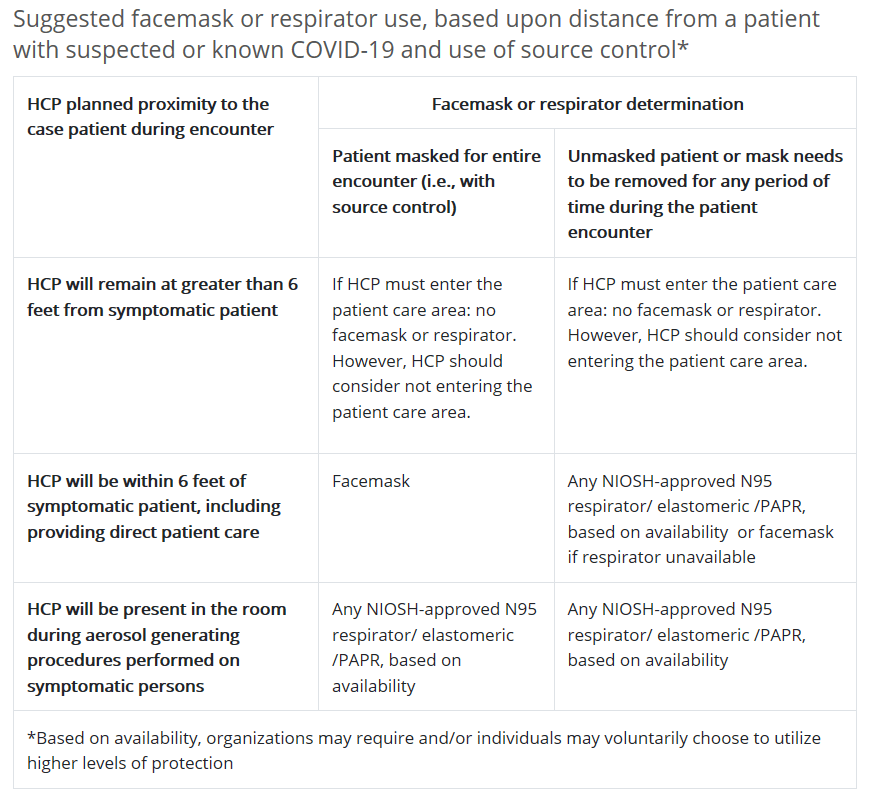
Due to the shortage of N95 masks, the DFD will also start collecting used N95s to prepare for the possible utilization of Battelle’s Critical Care Decontamination System process. They’ve provided the following procedure as an example:
State Board of Emergency Medical, Fire, and Transportation Services – Public Access to Meeting (2020-04-14)
In support of Governor DeWine’s declared state of emergency (Executive Order 2020-01D) and the ongoing COVID-19 pandemic, the Emergency Medical, Fire, and Transportation Services Board will be meeting via videoconference on April 15, 2020 at 10:00 AM. For public viewing of this meeting, please click on this link. If the public wishes to participate in an open forum, please call 614-981-4564.
Fire Fighter and Fire Safety Inspector Training Committee Public Access to Meeting (2020-04-14)
Fire Fighter and Fire Safety Inspector Training Committee Public Access to Meeting In support of Governor DeWine’s declared state of emergency (Executive Order 2020-01D) and the ongoing COVID-19 pandemic, the Fire Committee of the Emergency Medical, Fire, and Transportation Services Board will be meeting via videoconference on April 15, 2020 at 2:00 PM. For public viewing of this meeting, please click on the this link. If the public wishes to participate in an open forum, please call 614-981-4564.
COVID-19 Guidance for First Responders – Federal Healthcare Resilience Task Force (2020-04-14)
The Federal Healthcare Resilience Task Force recently published two documents to support EMS workers responding during COVID-19. Linked below, these documents can also be helpful to responders from other fields:
- Managing Patient and Family Distress Associated with COVID-19: Tips for EMS Personnel
- Mitigate Absenteeism by Protecting EMS Clinicians’ Psychological Health and Well-being During the COVID-19 Pandemic
The Federal Healthcare Resilience Task Force is comprised of the Federal Emergency Management Agency, the Army Corps of Engineers, and the U.S. Department of Health and Human Services Assistant Secretary for Preparedness and Response.
Certification Renewal and Continuing Education Relief During COVID-19 Emergency (2020-04-14)
On Friday, March, 27, 2020 Governor DeWine signed Amended Substitute House Bill 197 (HB 197) which includes many provisions intended to respond to the ongoing COVID-19 pandemic. This Bill includes relief to certificate holders whose certificates expire during the state of emergency declared by the Governor through Executive Order 2020-01D, issued March 9, 2020.
Certification-Renewal-and-Continuing-Education-Relief-During-COVID-19-Emergency
20200414 – 0800 State EOC SitRep (2020-04-14)
Here is the 8AM SITREP detailing State EOC Operations over the past 24 hours as of 0800 April 14, 2020.
For additional COVID-19 information, explore the ESF-5 Resource Portal and the following highlighted applications:
- Ohio Sentry: COVID-19 Mobile Monitoring
- Ohio Sentry: COVID-19 Hub Site (desktop)
- Ohio EMA: State EOC Daily Ops Report
Disposal of Waste from Patients with Suspected or Known COVID-19 Infection (2020-04-13)
The Ohio Department of Public Safety, Division of EMS has recently received inquiries regarding the management of waste following the treatment of a patient with suspected or known COVID-19 infection. The current CDC recommendations state that the management of laundry, food service utensils, and medical waste should also be performed in accordance with routine procedures.
Family Distancing Options for First Responders (2020-04-13)
The Ohio Division of EMS and The Ohio Fire Academy have been advised that many of our brothers and sisters across the state are staying in campers, garages, and even cars because of the fear of exposing their families to the COVID virus. All of these folks still working in the streets are already under enough stress and risk without having to risk their families or endure the austere conditions of living in their garage for weeks on end. Below are several free options that are available for Ohio’s first responders and healthcare workers.
Family-distancing-options-for-Ohios-first-responders-and-healthcare-workers.
Webinar: Legal and Documentation Issues for EMS Field Practitioners (2020-04-13)
PWW is teaming up with NAEMT and Lexpipol/EMS1 to present a special free national EMS law webinar geared specifically for EMS field practitioners on Friday, April 17th at 2pm EDT (11am PDT / 1pm CT). Sign up for this important event HERE.
PWW-Co-Hosting-National-COVID-19-Documentation-Legal-Webinar-for-EMS-Providers
DFD COVID-19 Daily Report 20200413 (2020-04-13)
National Police Foundations – COVID-19 Resources for Law Enforcement (2020-04-13)
Featuring a real time Law Enforcement impact dashboard!
Shared by Major Wendy Stiver, Dayton Police Department.
Agencies can input their own data to help track exposures and PPE needs.
Data will likely be used to support future funding to better prepare for the next pandemic or next wave of this one.
NPF is funded by federal grant, private industry (like Microsoft) and foundation funding.
20200413 – 0800 State EOC SitRep (2020-04-13)
Here is the 8AM SITREP detailing State EOC Operations over the past 24 hours as of 0800 April 13, 2020.
For additional COVID-19 information, explore the ESF-5 Resource Portal and the following highlighted applications:
- Ohio Sentry: COVID-19 Mobile Monitoring
- Ohio Sentry: COVID-19 Hub Site (desktop)
- Ohio EMA: State EOC Daily Ops Report
CMS Allows for “Verbal Consent” by COVID-19 Patients (2020-04-13)
Several weeks ago, PWW and other industry groups asked CMS for relief from signature rules because of the impracticability of obtaining Assignment of Benefits (AOB) signatures from suspected or actual COVID-19 patients. Now, CMS has officially acknowledged that due to CDC Guidelines, it is improper to ask suspected or known COVID patients to handle styluses, pens and other devices or equipment used to obtain signatures due to the infection risk.
BREAKING-ALERT-Official-Answer-on-Beneficiary-Signature-Rules
CARES Act Relief Payments Begin Today (2020-04-13)
Ambulance service suppliers will begin seeing their portion of $30 billion under the CARES Act today. This represents only part of the $100 billion in total that is available under the Act, the remaining $70 billion to be distributed at a later time.
Flu Report – MMWR Week 14 (2020-04-11)
Flu activity has been downgraded to regional in Ohio and continues to decrease across much of the U.S. Please see the following flu report for MMWR week 14.
Influenza activity is decreasing in Montgomery County and across WCO (only 1 hospitalization reported in week 14). Note that emergency department indicators and thermometer sales data after week 9 are likely skewed due to COVID-19. The number of hospitalizations reported for Ohio during week 14 was 121 – a 47% decrease from last week.
Nationally, flu activity is decreasing, and laboratory-confirmed flu activity is low; ILI activity has decreased but is still elevated likely due to COVID-19.
The CDC estimates 39-56 million illnesses, 410,000-740,000 flu hospitalizations, 24,000-62,000 total flu deaths, and confirms 166 pediatric deaths so far this flu season.
Correctional Facility Guidance (2020-04-10)
Exposure and Risk Mitigation Best Practices for Law Enforcement (2020-04-10)
COVID-10-LE-Risk-Mitigation-and-Exposure-Best-Practices-_Final
20200410 – 0800 State EOC SitRep (2020-04-10)
Here is the 8AM SITREP detailing State EOC Operations over the past 24 hours as of 0800 April 10, 2020.
For additional COVID-19 information, explore the ESF-5 Resource Portal and the following highlighted applications:
- Ohio Sentry: COVID-19 Mobile Monitoring
- Ohio Sentry: COVID-19 Hub Site (desktop)
- Ohio EMA: State EOC Daily Ops Report
DFD COVID-19 Daily Report 20200409 (2020-04-09)
Call Stacking – Shared Information (2020-04-09)
Montgomery County Sheriff Sgt. Lewis of RDC shares this information on call stacking:
This is where I am at on stacking. Using WT as our Guinee Pig, they request to have all ALPHA and OMEGA (minus EMD 9 Omega) stacked. They also requested the following Fire Call Types stacked:
- INVEST – wires, smoke, misc, illegal
- FIRE – tree and small grass
- Elevator – no Illness
- FALARM – residence
- Water – structure or street
- CO – no Illness
- Lift – no injury
For time’s sake and also easier flexibility I created a new monitor view for our dispatchers. Doing so allows them to simply change their monitor view, allowing all the calls I marked for stacking to appear in a “Fire Pending (STACKED CALLS)” window. Doing it this way allows the call type to route to appropriate pending window and also means you and I do not need to change responses or use a command to place an agency in storm mode.
Having everyone stack the same call types is how I have it set at the moment (the calls mentioned above). That being said, I understand an agency may have additional BRAVO or maybe even a few CHARLIE calls they want assigned to STACK. Because of this possibility I am building another view that will have separate stacking windows for each agency.
I have attached a screen shot of what the dispatchers would be monitoring. The top window is stacked and the bottom window is pending calls that are not stacked. I will work this weekend to build out the second option for individual agencies. Early next week, I will have a video put together, and sent to each RDC fire client, demonstrating both options.
God willing we will not have to use this, but if we do, we will assign a 4th fire dispatcher to monitor stacked calls ONLY. They will assign each stacked/pending call as requested by a unit on RDC FIRE 1.
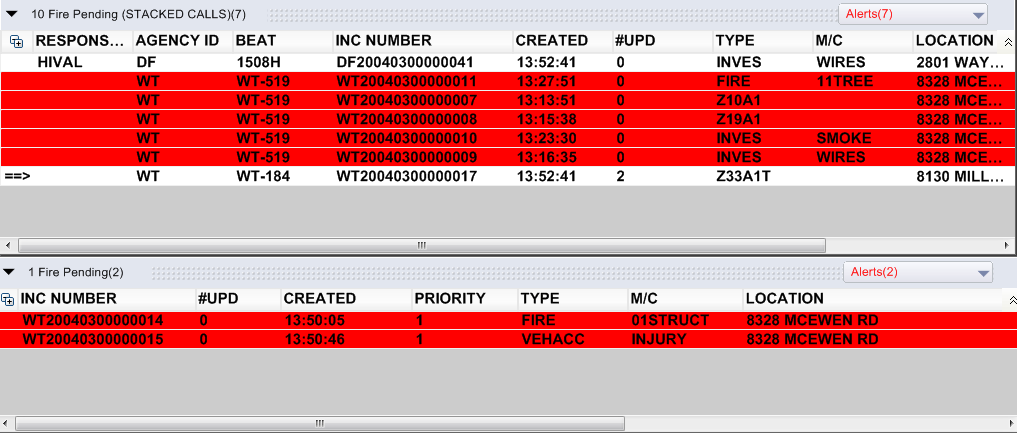
OEMS-ODPS: PPE Guidance for Firefighters, EMS (2020-04-09)
DFD COVID-19 Daily Report 20200408 (2020-04-08)
Ohio COVID-19 Update – April 8, 2020 (2020-04-08)
DFD – Nursing Home Letter (2020-04-08)
Thanks to Chiefs Lykins and Hosford from Dayton Fire Department for this sample letter to an extended care facility to use as an example.
WTFD – Nursing Home Letter (2020-04-08)
Thanks to Scott Kujawa, Fire Chief of Washington Township Fire Department for this letter to an extended care facility for use as an example:
Flu Report – MMWR Week 13 (2020-04-08)
Flu activity remains widespread across Ohio but is decreasing throughout Ohio and much of the U.S. Please see the attached flu report for MMWR week 13. Influenza activity is decreasing in Montgomery County and across WCO.
Note that emergency department indicators and thermometer sales data after week 9 are likely skewed due to COVID-19. The number of hospitalizations reported for Ohio during week 13 was 228 – a 58% decrease from last week.
Nationally, flu activity remains high, but laboratory-confirmed flu activity decreased; ILI activity is still elevated likely due to COVID-19. The CDC estimates 39-55 million illnesses, 400,000-730,000 flu hospitalizations, 24,000-63,000 total flu deaths, and confirms 162 pediatric deaths so far this flu season.
20200408 – 0800 State EOC SitRep (2020-04-08)
Here is the 8AM SITREP detailing State EOC Operations over the past 24 hours as of 0800 April 8, 2020.
For additional COVID-19 information, explore the ESF-5 Resource Portal and the following highlighted applications:
- Ohio Sentry: COVID-19 Mobile Monitoring
- Ohio Sentry: COVID-19 Hub Site (desktop)
- Ohio EMA: State EOC Daily Ops Report
Ohio Minimum Staffing Reporting Process (2020-04-08)
This memo is to clarify questions regarding the requirements for when an EMS agency can reduce to minimum staffing on the ambulance.
Ohio COVID-19 Update – April 6, 2020 (2020-04-08)
FAQ ON COVID-19 AND OPERATIONAL K9S (2020-04-08)
Reporting Possible COVID-19 Related Incidents in EMSIRS (2020-04-08)
| Reporting Possible COVID-19 Related Incidents in the Emergency Medical Services Incident Report System (EMSIRS) |
The National Emergency Medical Services Information System (NEMSIS) has issued guidance to states on collecting information for EMS runs that may be COVID-19 related. They have recommended three ICD-10 codes that can be used as the secondary impression when reporting an incident to the state.
Based on the NEMSIS recommendation, the State of Ohio Division of EMS suggests that when reporting a COVID-19 related incident to EMSIRS, or an incident where the patient is COVID-19 compromised, one of the following ICD-10 codes be used for the Provider’s Secondary Impression (eSituation.12):
- Z20.828 – Contact with and (suspected) exposure to other viral communicable diseases. Use when the patient is known or suspected to have been exposed to someone with COVID-19.
- Z20.9 – Contact with and (suspected) exposure to unspecified communicable disease. Use when the patient is suspected to have been exposed to an infectious disease, but the EMS clinician does not know if it was COVID-19. The patient has symptoms but exposure is unknown.
- B97.29 – Other coronavirus as the cause of diseases classified elsewhere. Use for positive COVID-19 diagnosis. (Do NOT use U07.1 (recommended by the CDC) as it will cause NEMSIS compliant XML to fail.)
The Division of EMS is dedicated to statewide collection of accurate information for the improvement of the health and safety of all Ohioans.
DFD COVID-19 Daily Report 20200407 (2020-04-08)
20200407 – 0800 State EOC SitRep (2020-04-07)
Here is the 8AM SITREP detailing State EOC Operations over the past 24 hours as of 0800 April 6, 2020.
For additional COVID-19 information, explore the ESF-5 Resource Portal and the following highlighted applications:
- Ohio Sentry: COVID-19 Mobile Monitoring
- Ohio Sentry: COVID-19 Hub Site (desktop)
- Ohio EMA: State EOC Daily Ops Report
What EMS and 911 need to know about COVID 19 (2020-04-06)
Crisis Standards of Care and COVID-19: What EMS Needs to Know (2020-04-06)
Crisis Standards of Care and COVID-19: What EMS Needs to Know – March 26, 2020 from the federal office of EMS at NHTSA
DFD COVID-19 Daily Report 20200406 (2020-04-06)
Cleaning of Technology Equipment (2020-04-06)
The Dayton Fire Department has provided the following guideline for departments to use as an example:
Cleaning of Mobile Technology Devices will be done in accordance with the manufacturers recommendations. The Dayton Fire Department’s primary cleaning agents will be Sani-Cloth Disposal Cloths, Alcohol Prep Swabs, or Clorox Wipes. All units may be surface decontaminated by crews; however, the units are NOT to be submerged for cleaning. If the device is soiled beyond the ability to reasonably clean with the above procedures, the device will be taken out of service and sent to the Tech Unit for complete decontamination or replacement.
Criteria for Discontinuation of Isolation Precautions (2020-04-06)
CDC has released non-test-based criteria for discontinuation of home isolation and criteria for return to work for healthcare personnel with confirmed or suspected COVID-19. The non-test-based strategies include:
- At least 3 days (72 hours) have passed since recovery defined as resolution of fever without the use of fever-reducing medications and improvement in respiratory symptoms (e.g., cough, shortness of breath); AND,
- At least 7 days have passed since symptoms first appeared.
For hospitalized patients with COVID-19, test-based criteria for discontinuation of transmission-based precautions is available on the CDC website here. Guidance is also available for “Discontinuation of In-Home Isolation for Immunocompromised Persons with COVID-19”.
Self Quarantine Guidance Update (2020-04-06)
DFD Operational Slides 20200406 (2020-04-06)
Few notes on weekend trends:
1. Runs appear to be holding around average, though the overall monthly trend is still going down.
2. We had a large increase in “Sick” calls over this weekend, and an increase in runs in which our crews thought COVID-19 may be a factor on Friday. I will be looking into these.
3. DOA and field terminations are trending down again, though trending is not 100% reliable due to the 3/17 aberration.
COVID Points for Public Safety #3 (2020-04-06)
COVID Points for EMS
- Emergency Departments in the region continue to see patients brought in by EMS where patients are not wearing masks.
- Putting a mask on the patient is the most important first step in protecting both EMS and emergency department personnel.
- Consider placing a mask on all patients with illness particularly from group living situations, including but not limited to nursing homes/long-term care facilities.
- If supplemental O2 is needed, use it under the patient mask.
- Expect to see a new MMRS/EMS Council COVID-19 Bulletin with additional guidance on this very soon.
Yoda’s COVID Points are brought to you by Dayton MMRS with approval from Dr. Marriott, Region 3 RPAB Chair. We gratefully acknowledge the help and support of GMVEMSC, and public health, public safety, emergency management and other agencies and individuals throughout the region.
Please send suggestions for future Yoda Points to david.gerstner@daytonohio.gov.
20200406 – 0800 State EOC SitRep (2020-04-06)
Here is the 8AM SITREP detailing State EOC Operations over the past 24 hours as of 0800 April 6, 2020.
For additional COVID-19 information, explore the ESF-5 Resource Portal and the following highlighted applications:
- Ohio Sentry: COVID-19 Mobile Monitoring
- Ohio Sentry: COVID-19 Hub Site (desktop)
- Watch Office: Dashboard for Display
- Ohio EMA: State EOC Daily Ops Report
Guidance on the use of Masks (2020-04-05)
Following updated recommendations from the CDC, the IAFF has released the following recommendations:
Following new guidance announced by the Centers for Disease Control and Prevention (CDC) recommending that the public voluntarily wear non-medical basic cloth or fabric masks, the IAFF strongly recommends that members begin wearing surgical masks at the fire station and to consider donning a surgical mask at home around family members to help reduce the spread of COVID-19, as well as sustain a sufficient workforce to protect our communities across the United States and Canada.
Download the IAFF COVID-19 guidance on Surgical Masks: Reducing Potential Exposure.
The guidance referenced states in part, “…CDC recommends wearing cloth face coverings in public settings where other social distancing measures are difficult to maintain (e.g., grocery stores and pharmacies) especially in areas of significant community-based transmission.
It is critical to emphasize that maintaining 6-feet social distancing remains important to slowing the spread of the virus. CDC is additionally advising the use of simple cloth face coverings to slow the spread of the virus and help people who may have the virus and do not know it from transmitting it to others. Cloth face coverings fashioned from household items or made at home from common materials at low cost can be used as an additional, voluntary public health measure.
The cloth face coverings recommended are not surgical masks or N-95 respirators. Those are critical supplies that must continue to be reserved for healthcare workers and other medical first responders, as recommended by current CDC guidance.
This recommendation complements and does not replace the President’s Coronavirus Guidelines for America, 30 Days to Slow the Spread …”
IAFC PPE Decon Recommendations (2020-04-03)
City of Dayton Quarantine / Isolation Facility (2020-04-03)
The City of Dayton has established a Quarantine/Isolation Facility as an option for Public Safety members who have been placed in quarantine by PHDMC. The Greater Dayton Recreation Center at 2021 W. Third St has been designated as a Quarantine/Isolation Facility for First Responders in the Region.
The facility is currently set up with 14 beds (10 in the male dorm and 4 in the female dorm). Each cot has a blanket and personal care items (toothbrush, toothpaste, deodorant, washcloth, soap, comb). The facility has a limited kitchen area with refrigeration and microwaves (no stove). We have 72 MRE’s (including vegetarian) and a pallet of water. There are showers and lockers (we do not have any locks at this time). We are working to set up Wi-Fi. Capacity for additional personnel may be added to this facility if needed and a second facility has been identified.
The City of Dayton has established an electronic registration system to intake and track guests during their quarantine period. The shelter is fully set up and is operational at this time but currently is not staffed. It may be placed in service over the weekend if needed. To request the shelter to be opened at any time 24/7, please contact the Dayton Fire Department Health and Safety line at 937 333-4530, DFD Captain Merritt Colton at 937 416-5082, or DPD Sgt. Steven Clark at 937 673-9168.
DFD COVID-19 Daily Report 20200403 (2020-04-03)
20200403 – 0800 State EOC SitRep (2020-04-03)
Here is the 8AM SITREP detailing State EOC Operations over the past 24 hours as of 0800 April 3, 2020.
For additional COVID-19 information, explore the ESF-5 Resource Portal and the following highlighted applications:
- Ohio Sentry: COVID-19 Mobile Monitoring
- Ohio Sentry: COVID-19 Hub Site (desktop)
- Watch Office: Dashboard for Display
- Ohio EMA: State EOC Daily Ops Report
Rapid COVID-19 Blood Tests and the Ohio EMS Scope of Practice (2020-04-02)
Per Ohio Administrative Code 4765-17-03(A)(24), the performance of rapid COVID-19 blood testing is within the Ohio EMS scope of practice for certified Ohio Paramedics with authorization, a written protocol, training, continuing education, and a quality assurance program provided by the EMS medical director. The performance of rapid COVID-19 blood testing is not within the Ohio EMS scope of practice for certified Ohio emergency medical responders (EMRs), emergency medical technicians (EMTs), or advanced emergency medical technicians (AEMTs). Per Ohio Administrative Code 4765-15-04(B)(13), analysis of blood is limited to glucose monitoring for EMTs and AEMTs.
Rapid-COVID-19-Blood-Tests-and-the-Ohio-EMS-Scope-of-Practice
WPAFB FD Policy 4 – Station Entry and Screening (2020-04-02)
WPAFB FD Chief Jacob King has provided these policies for use as examples.
WPAFB FD Policy 3 – Movements and Station Visitors (2020-04-02)
WPAFB FD Chief Jacob King has provided these policies for use as examples.
WPAFB FD Policy 2 – Uniform Management (2020-04-02)
WPAFB FD Chief Jacob King has provided these policies for use as examples.
WPAFB FD Policy 1 – Disinfection (2020-04-02)
WPAFB FD Chief Jacob King has provided these policies for use as examples.
Response Guidelines For Xenia Fire Division Personnel (2020-04-02)
Xenia has shared these COVID-19 Response Guidelines For Xenia Fire Division Personnel
Response Guidelines For Xenia Police Division Personnel (2020-04-02)
Xenia has shared these COVID-19 Response Guidelines For Xenia Police Division Personnel
COVID-19 Response Guideline Job Aid (2020-04-02)
Xenia has shared this COVID-19 Response Guideline Job Aid:
DFD COVID-19 Daily Report 20200402 (2020-04-02)
Guidance for Utilizing and Optimizing Personal Protective Equipment (2020-04-02)
April 1, 2020. Update from Health Alert released March 25, 2020
Summary and Action Items
- The Centers for Disease Control and Prevention (CDC) has provided guidance on “Strategies to Optimize the Supply of Personal Protective Equipment (PPE) and Equipment”, including eye protection, isolation gowns, facemasks, N95 respirators, and ventilators.
- CDC has also provided guidance for “Frequently Asked Questions about Personal Protective Equipment”.
- The Ohio Department of Health (ODH) is releasing guidance and instruction materials (print and video) related to optimizing PPE for healthcare facilities developed by ODH, CDC, Emory University School of Medicine, and Nebraska Medicine. These resources are also available on the Ohio Public Health Communication System (OPHCS) site under Documents > EPI Issues > 2019 Novel Coronavirus > Strategies for Optimizing PPE.
- ODH is recommending that all staff in long-term care facilities wear a surgical/medical facemask while working to avoid asymptomatic transmission of COVID-19 to residents and other staff. This includes facilities not known to be affected by COVID-19.
- In settings where facemasks are not available, healthcare personnel (HCP) might use homemade masks (e.g., bandana, scarf) for care of patients with COVID-19 as a last resort. However, homemade masks are not considered PPE, since their capability to protect HCP is unknown. Caution should be exercised when considering this option. Homemade masks should ideally be used in combination with a face shield that covers the entire front (that extends to the chin or below) and sides of the face.
Attached resources (also posted in OPHCS) are listed below (see links below this announcement):
- Strategies for Optimizing PPE
- Instructions for Reuse of Facemasks
- Instructions for N95 Respirator Use
- Printable Instructions and Videos for Optimizing PPE
- PPE Contingency Planning
Contact
Immediately report all confirmed cases of COVID-19 to the local health department in the jurisdiction in which the case resides. To locate a local health department, please visit https://odhgateway.odh.ohio.gov/lhdinformationsystem/Directory/GetMyLHD.
For general questions related to COVID-19, healthcare providers and facilities should contact their local health department. Ohio local health departments should contact the ODH Bureau of Infectious Diseases at 614-995-5599.
DFD Operational Slides 20200402 (2020-04-02)
Average run volume continues to decrease, and though patients found dead on arrival/field terminated is trending upward, there were none to report yesterday.
20200402 – 0800 State EOC SitRep (2020-04-02)
Here is the 8AM SITREP detailing State EOC Operations over the past 24 hours as of 0800 April 2, 2020.
For additional COVID-19 information, explore the ESF-5 Resource Portal and the following highlighted applications:
- Ohio Sentry: COVID-19 Mobile Monitoring
- Ohio Sentry: COVID-19 Hub Site (desktop)
- Watch Office: Dashboard for Display
- Ohio EMA: State EOC Daily Ops Report
COVID Points for Public Safety #2 (2020-04-02)
COVID Points for EMS
- Aerosol-generating procedures (AGPs) can be lifesaving. They also present risks to everyone in the vicinity when the patient has a highly contagious disease.
- AGPs include CPAP, CPR, nebulizers, intubation, Bi-PAP, suctioning, and high-flow O2 by mask.
- When using a NRM or cannula, place a mask on the patient over the O2 apparatus.
- If using a BVM, consider placing a towel on the airway to contain aerosol.
- Yes, you need to conserve PPE. But if you’re performing an AGP, you and anyone in the back of the ambulance need to be in N95s or PAPRs.
- Always call the ED for every suspected COVID patient!
- Make sure you follow the receiving facility’s entry instructions. Hospital personnel may choose to meet you on the ramp to mitigate AGPs; as an example, the may add a HEPA filter between an ETT or trach tube and the BVM.
- All AGPs require notification, even if you’re transporting from a facility who says that they contacted the receiving hospital.
- Notify the hospital about AGPs whether you suspect COVID or not.
- When you arrive at the hospital, AGPs need to stop during the brief transit from the ED entrance to the room so we aren’t spraying the air with aerosols generated by the procedure.
- The exception is CPR (don’t stop that!), but even bagging can be stopped for the 30 seconds or so until you get into a room where hospital personnel are in PPE.
Yoda’s COVID Points are brought to you by Dayton MMRS with approval from the Region 3 RPAB Chair. We gratefully acknowledge the help and support of GMVEMSC, and public health, public safety, emergency management and other agencies and individuals throughout the region.
Please send suggestions for future Yoda Points to david.gerstner@daytonohio.gov.
20200401 – 0800 State EOC SitRep (2020-04-01)
Here is the 8AM SITREP detailing State EOC Operations over the past 24 hours as of 0800 April 1, 2020.
For additional COVID-19 information, explore the ESF-5 Resource Portal and the following highlighted applications:
- Ohio Sentry: COVID-19 Mobile Monitoring
- Ohio Sentry: COVID-19 Hub Site (desktop)
- Watch Office: Dashboard for Display
- Ohio EMA: State EOC Daily Ops Report
DFD COVID-19 Daily Report 20200401 (2020-04-01)
FBI Warning for ‘Zoom-Bombings’ on Online Video Meeting Apps (2020-04-01)
Zoom has been a godsend to the US economy, giving people the ability to quickly set up massive video conferences in just a few minutes. Unfortunately a quirk of the default configuration allows participants to hijack the conference and share their screens with the entire group. Now the FBI’s Boston field office has issued a new warning after hijackers infiltrated two school-held Zoom sessions to harass a teacher and display the Swastika sign. For new Zoom users, there’s a primer on how to prevent Zoom-bombing and some overall Zoom tips here.
2020-03 · 73 entries
Video: Conservation of PPE (2020-03-31)
Conservation of PPE by David Gerstner, from the press conference of Health Commissioner Jeff Cooper.
20200331 – 0800 State EOC SitRep (2020-03-31)
Here is the 8AM SITREP detailing State EOC Operations over the past 24 hours as of 0800 March 31, 2020.
For additional COVID-19 information, explore the ESF-5 Resource Portal and the following highlighted applications:
- Ohio Sentry: COVID-19 Mobile Monitoring
- Ohio Sentry: COVID-19 Hub Site (desktop)
- Watch Office: Dashboard for Display
- Ohio EMA: State EOC Daily Ops Report
Quarantine Station Support Plan (2020-03-31)
This is version 1 of the Quarantine Station Support Plan. This plan is intended to be a guidance document on setting up potential quarantine sites here in Ohio. This plan was developed in partnership by ESF6 (Mass Care), ESF8 (Public Health) and various partners.
The Quarantine Station Support Plan was developed to support the provision of guidance to local jurisdictions for the establishment of a comprehensive quarantine station designed to provide essential services. Quarantine stations will be utilized to limit the spread of COVID-19 within communities, and are not intended to support the relocation of long-term care facilities or hospitals, although these efforts may be supported by some of the strategies detailed herein.
This is a living document, and as the situation changes there will be updates.
COVID-19_QuarantineStationSupportPlan_WorkingDraft_v1_20200330
DFD COVID-19 Daily Report 20200331 (2020-03-31)
Please see the attached report. Of note, as of today the U.S. has nearly double the amount of cases at that which was officially reported by China. That being said our mortality is holding at roughly 1/3 theirs.
In addition, at request of Dr. Marriott I have added two additional slides.
The first (slide 16) is a breakdown of call types and crew impressions. The call types (in green) are by dispatch nature each day for incident types that could been seen with a potential COVID-19 patient. The crew impression (in red) are those calls in which our crews either put potential COVID-19 as a primary or secondary impression, or filled out the Outbreaks Screening form.
The second new slide (17) is tracking of non-traumatic field termination patients. This will now be tracked to look for trends of increasing mortality being seen in the field. Of note, this is currently trending up, and as such I will monitor. If a more detailed inspection of potential causes is desired please let me know.
FEMA Releases Updated Resilience Analysis and Planning Tool (RAPT) (2020-03-31)
FEMA released expanded capabilities to the Resilience Analysis and Planning Tool (RAPT), including census tract data and additional infrastructure layers for all state, local, tribal and territorial jurisdictions across the nation. This update to the tool enables a more granular analysis of community resilience indicators and allows users to calculate the population of individuals with specific indicator characteristics in selected census tracts.
Jurisdictions at all levels, other federal agencies, the private sector, and nongovernmental organizations can use RAPT to inform strategies for preparedness, response and recovery activated related to the coronavirus pandemic and other disasters. The tool is a free-to-use Geographic Information System (GIS) webmap tool that allows users to combine layers of community resilience indicators, infrastructure locations, and hazard data to visualize, prioritize and implement strategies to impact resilience, response, and recovery.
The updated RAPT provides important census-tract level demographic information and infrastructure locations related to coronavirus pandemic planning and response efforts. This includes the location and size of infrastructure entities such as hospitals, nursing homes, urgent care facilities, public health departments, and pharmacies; population count and demographics of individuals within a containment zone (e.g. over age 65, disability, educational attainment); and visualization tools.
The RAPT is publicly available at https://bit.ly/ResilienceAnalysisandPlanningTool. Supporting documents for RAPT, including an overview document, user guide and information about the data layers and sources, can be found at https://www.fema.gov/de/media-library/assets/documents/176618.
The National Integration Center will host three 60-minute training webinars over the next two weeks, starting on April 2, to provide additional background on the RAPT, demonstrate multiple capabilities and answer questions from RAPT users. Webinars are open to all.
Advance registration is not required, but space is limited to 150 participants per webinar. Real-time captioning will be available. To participate, please click on your preferred webinar session from the list below at the beginning of the webinar to begin and call the phone number provided:
Thursday, April 2, 12-1 p.m. ET
Participate: https://fema.connectsolutions.com/resilienceindicatorgis/
Audio Call-in: 202-795-3352. PIN: 253 361 211#
Tuesday, April 7, 3-4 p.m. ET
Participate: https://fema.connectsolutions.com/resilienceindicatorgis/
Audio Call-in: 202-795-3352. PIN: 253 361 211#
Thursday, April 9, 12-1 p.m. ET
Participate: https://fema.connectsolutions.com/resilienceindicatorgis/
Audio Call-in: 202-795-3352. PIN: 253 361 211#
For more information, please contact FEMA-TARequest@fema.dhs.gov.
Ohio EMA Warns About Scam Phone Calls (2020-03-30)
DFD COVID-19 Daily Report 20200330 (2020-03-30)
20200330 – 0800 State EOC SitRep (2020-03-30)
Here is the 8AM SITREP detailing State EOC Operations over the past 24 hours as of 0800 March 30, 2020.
For additional COVID-19 information, explore the ESF-5 Resource Portal and the following highlighted applications:
- Ohio Sentry: COVID-19 Mobile Monitoring
- Ohio Sentry: COVID-19 Hub Site (desktop)
- Watch Office: Dashboard for Display
- Ohio EMA: State EOC Daily Ops Report
20200329 – 0800 State EOC SitRep (2020-03-29)
Here is the 8AM SITREP detailing State EOC Operations over the past 24 hours as of 0800 March 29, 2020.
For additional COVID-19 information, explore the ESF-5 Resource Portal and the following highlighted applications:
- Ohio Sentry: COVID-19 Mobile Monitoring
- Ohio Sentry: COVID-19 Hub Site (desktop)
- Watch Office: Dashboard for Display
- Ohio EMA: State EOC Daily Ops Report
20200328 – 0800 State EOC SitRep (2020-03-28)
Here is the 8AM SITREP detailing State EOC Operations over the past 24 hours as of 0800 March 28, 2020.
For additional COVID-19 information, explore the ESF-5 Resource Portal and the following highlighted applications:
- Ohio Sentry: COVID-19 Mobile Monitoring
- Ohio Sentry: COVID-19 Hub Site (desktop)
- Watch Office: Dashboard for Display
- Ohio EMA: State EOC Daily Ops Report
DFD COVID-19 Daily Report 20200327 (2020-03-27)
20200327 – 0800 State EOC SitRep (2020-03-27)
Here is the 8AM SITREP detailing State EOC Operations over the past 24 hours as of 0800 March 27, 2020.
For additional COVID-19 information, explore the ESF-5 Resource Portal and the following highlighted applications:
- Ohio Sentry: COVID-19 Mobile Monitoring
- Ohio Sentry: COVID-19 Hub Site (desktop)
- Watch Office: Dashboard for Display
- Ohio EMA: State EOC Daily Ops Report
DFD COVID-19 Daily Report 20200326 (2020-03-26)
Two things of note:
- France did not update their numbers at the time of this report.
- I changed the starting date for the epidemiological curves to the date of first diagnosed case to better reflect actual growth (all were originally 21-Jan). This has changed the appearance of some of the curves.
COVID Points for Public Safety #1 (2020-03-26)
We’re going to start sending brief messages related to the coronavirus pandemic. Please share with all public safety personnel, including law enforcement, fire, EMS, EMA, and dispatchers. Remember, “There is no try.”
- Conserve PPE – all infectious disease PPE is running low; some areas are already completely out of certain items. Re-using the good stuff is better than using something makeshift.
- Social distancing applies to us, too. As one example, having a dozen people crammed into the EMS room at the hospital is not a great idea.
- Do you need to put a mask on your patient? It depends. A shooting victim with a fever needs a mask. A patient with a sprained ankle and no symptoms of COVID does not. Protect yourself, but use good judgment, and remember CONSERVE. We’re running out of surgical masks, too.
- People have called agencies to take a patient to the ED for COVID testing. If all the person wants is testing, that should be done elsewhere. Not the ED. And not by EMS.
- Can EMS personnel get tested for COVID? The rules changed in the last few days: Yes.
- Public safety personnel (LE, EMS, fire) who are symptomatic can be tested if their physician orders the test. We are in “Tier 2” for testing according to ODH.
- Unless actually hospitalized, tests for our personnel are not run by the ODH labs; they go to one of the approved private labs, which means it takes an extra day or two to get results.
Ohio: New COVID-19 Data Dashboard Unveiled (2020-03-26)
March 26, 2020
An expanded COVID-19
data dashboard has been designed by the InnovateOhio Platform and is now
available online.
The dashboard
displays the most recent preliminary data reported to the Ohio Department of
Health (ODH) about COVID-19 cases, hospitalizations, and deaths in Ohio by
selected demographics and county of residence.
There are 867
confirmed cases of COVID-19 in Ohio and 15 deaths. A total of 223 people have
been hospitalized, including 91 admissions to intensive care units.
In-depth data on the
new dashboard can be accessed by visiting coronavirus.ohio.gov.
Video of today’s full
update, including versions with foreign language closed captioning, can be
viewed on the Ohio Channel’s YouTube page.
For more information
on Ohio’s response to COVID-19, visit coronavirus.ohio.gov or
call 1-833-4-ASK-ODH.
Ohio: Personal Protective Equipment Needed (2020-03-26)
March 26, 2020 (COLUMBUS, Ohio)— Ohio Governor Mike DeWine, Lt. Governor Jon Husted, and Dr. Amy Acton, MD, MPH, today continued to remind Ohioans of the oncoming shortage of personal protective equipment (PPE) such as masks, goggles, gloves, gowns and face shields for healthcare workers and first responders.
Taking care of a
patient who is in intensive care for a 24-hour shift requires:
- 36 pairs of gloves
- 14 gowns
- 3 pairs of goggles
- 13 N-95 face masks.
The state of Ohio is asking residents and businesses who can
donate PPE, or any other essential service or resource, to email together@governor.ohio.gov.
Staff will receive these emails and coordinate how these resources
can best be used to benefit all Ohioans.
20200326 – 0800 State EOC SitRep (2020-03-26)
Here is the 8AM SITREP detailing State EOC Operations over the past 24 hours as of 0800 March 26, 2020.
For additional COVID-19 information, explore the ESF-5 Resource Portal and the following highlighted applications:
- Ohio Sentry: COVID-19 Mobile Monitoring
- Ohio Sentry: COVID-19 Hub Site (desktop)
- Watch Office: Dashboard for Display
- Ohio EMA: State EOC Daily Ops Report
Dayton VA Medical Center Updated Entry/Exit Gates to Facility (2020-03-26)
There is going to be an access modification for the VA Campus beginning this evening. The North Liscum gate will be tonight at 2000 hrs, and the South Liscum gate will be the new 24-hour accessibility gate for our campus.
1. Beginning on Friday morning, March 27, 2020, all employees must use the South Liscum gate to enter the Dayton VA. The South Liscum gate is the gate nearest State Route 35 and Liscum Drive. Note that patients and approved visitors may also use this entrance.
2. The North Liscum Avenue (Emergency) gate will be closing at 2000 hours Thursday, March 26, 2020 until further notice.
3. The Gettysburg Avenue Gate will be closing daily at 1730 hours and open daily at 0630 hours.
4. Changes above are reflected in the map below:
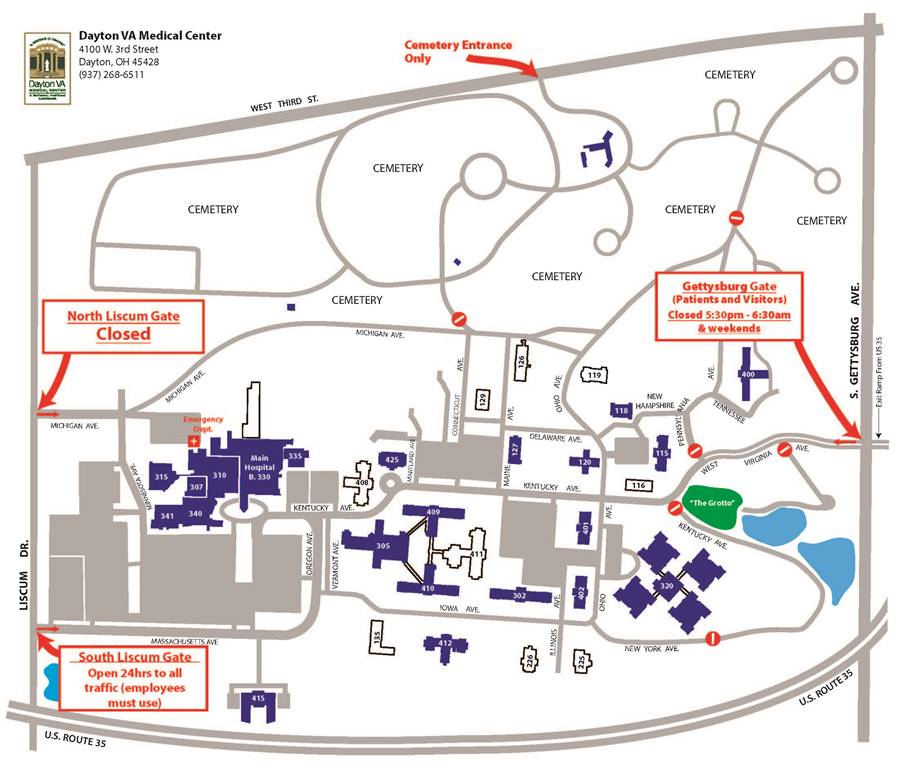
Please contact the Department of Veterans Affairs Police Dispatch Center via telephone (937-262-2160) if you have any additional questions.
DFD COVID-19 Daily Report 20200325 (2020-03-25)
Policy Update on GMVEMSC Protocol Testing (2020-03-25)
Due to current circumstances and guidelines that have been set forth by CDC, 2020 protocol testing will be extended until July 1, 2020. The following is a recommendation from GMVEMSC:
- Test in small groups (less than 8)
- Maintain six feet between providers
- Sanitize all equipment after each user has tested
- Practice employee screening prior to testing per GMVEMSC and CDC recommendations
- Use the opportunity during testing to emphasize the critical importance of repeated hygiene and the need to conserve PPE. We must conserve PPE now! Tomorrow is too late.
Protocols will go into effect July 1, 2020. If you have not completed a skill test for a new skill YOU MAY NOT USE THAT SKILL i.e. Breathing treatments at the EMT-Basic Level.
These dates are fluid and can possibly change at any time. We will re-evaluate the first part of April and decide if any adjustments need to be made.
PPE Guidance Continuing Education (2020-03-25)
WPAFB Chief Jacob King presents PPE Guidance for EMS and Law Enforcement in conjunction with Wright State University’s Calamityville, the National Center for Medical Rediness. 0.5 CEUs are available by watching the video and successfully completing the post test.
For continuing education credit, please complete the following information and video post test by visiting the test link below. Upon successful completion, a CE certificate will be send to the email address provided.
20200325 – 0800 State EOC SitRep (2020-03-25)
Here is the 8AM SITREP detailing State EOC Operations over the past 24 hours as of 0800 March 25, 2020.
CDC Information and Guidance (2020-03-24)
People who are sick are asked to follow CDC guidance on recovering at home:
https://www.cdc.gov/coronavirus/2019-ncov/if-you-are-sick/steps-when-sick.html
On March 19, 2020, a new online
interactive COVID-19 symptom self-checker was launched.
https://www.cdc.gov/coronavirus/2019-ncov/symptoms-testing/index.html
- The self-checker helps users make decisions about seeking appropriate medical care. This system is not intended for diagnosis or treatment of COVID-19 or other diseases.
- As of the morning of March 20, 2020, approximately 25,000 users per hour had used the self-checker. The self-checker is being used by people from the United States and other countries.
On March 18, 2020, CDC
Principal Deputy Director Dr. Anne Schuchat did a Q&A on What to Expect
When You’re Expecting for an audience of 16 million new and expectant mothers.
Dr. Schuchat answered questions related to COVID-19 and pregnancy, infant
care, and breastfeeding.
https://www.whattoexpect.com/news/family/pregnancy-newborns-coronavirus-cdc-q-and-a
A CDC study published March 17
shows that younger people can develop serious COVID-19 illness requiring
hospitalization. This finding is different from the first reports from China.
Younger people are still much less likely to die from COVID-19 than older
people.
Older
people and people with severe chronic conditions should take special
precautions because they are at higher risk of developing serious COVID-19
illness.
On
March 19, CDC updated technical guidance and consumer information about
cleaning and disinfecting your home when someone is sick.
https://www.cdc.gov/coronavirus/2019-ncov/prepare/disinfecting-your-home.html
GDAHA Message for GMVEMSC Regarding PPE (2020-03-24)
Dear EMS
Partners,
With the
COVID-19 pandemic increasing our use of PPE, GDAHA hospitals have been asked by
Fire and EMS about resupplying the surgical masks that are used on a
patient.
The hospitals
of Premier Health, Kettering Health Network, and Dayton Children’s Hospital
will resupply the masks used on patients on a one-to-one basis. The
hospitals will not be responsible for resupplying the crews with PPE they used
for personal protection on the run.
The one-to-one
exchange will be evaluated on an ongoing basis and will remain in effect as
long as the hospital supplies allow for this exchange.
Please know that
the need for PPE is a concern for GDAHA, our hospitals, and all partners on the
frontlines of the COVID-19 crisis. We are working diligently with your regional
organizations to bring additional supplies into the region to support and
protect everyone.
Thank you,
Sarah Hackenbracht, President and CEO
Greater Dayton Area Hospital Association
20200324 – 0800 State EOC SitRep (2020-03-24)
Here is the 8AM SITREP detailing State EOC Operations over the past 24 hours as of 0800 March 24, 2020.
DFD COVID-19 Daily Report 20200324 (2020-03-24)
PHDMC SitRep 20200324 (2020-03-24)
March 24, 2020
Public Health – Dayton & Montgomery County, the Ohio Department of Health (ODH) Centers for Disease Control and Prevention (CDC) and World Health Organization (WHO) are closely monitoring an outbreak of respiratory illness caused by a novel (new) coronavirus (termed “COVID-19”) first identified in Wuhan City, Hubei Province, China in December 2019 and which continues to expand.
Dispatch Center Considerations (2020-03-23)
Processes and recommendations below were developed jointly with GMVEMSC, MMRS, RPAB, Public Health, law enforcement, and dispatch. Remember that dispatch centers are critical infrastructure! A list of precautions for the center and your personnel is below.
Each agency and Dispatch Center must determine their own course of action, and should discuss this with the medical director, but effective immediately we recommend that public safety dispatch centers throughout the region incorporate the following guidance.
Dispatch Center Considerations
Dispatch centers and dispatch/call-taking personnel are critical infrastructure! Take all appropriate precautions including:
1. Restrict access; only allow entry by essential persons.
2. Frequent hand hygiene. Hand-washing with soap and water is slightly more protective against COVID than use of hand sanitizer. Use both frequently.
3. Remind each other to perform hand hygiene and not to touch your face.
4. Sanitize work areas frequently, especially headsets, keyboards, desktops, telephones, etc.
5. Don’t forget to sanitize your personal cell phone.
6. Anyone who is ill must not report for work.
7. Consider developing employee screening before each person reports to work. Anyone who is ill should not be allowed to enter the dispatch center.
- Employee screening processes should include a standard for when the employee may return to work, such as requiring that the employee be symptom-free for 72 hours without use of medications (such as Tylenol, Motrin, or cough suppressant) that mask symptoms.
8. Consider the potential for some personnel (e.g., administrators) to work from home.
Shared Plan: CAD Call Stacking Mode (2020-03-23)
Washington Township has graciously shared this draft CAD Call Stacking Mode plan.
20200323 – 0800 State EOC SitRep (2020-03-23)
Here is the 8AM SITREP detailing State EOC Operations over the past 24 hours as of 0800 March 23, 2020.
Dispatch Processes for COVID-19 (2020-03-23)
Processes and recommendations below were developed jointly with GMVEMSC, MMRS, RPAB, Public Health, law enforcement, and dispatch.
Each agency and Dispatch Center must determine their own course of action, and should discuss this with the medical director, but effective immediately we recommend that public safety dispatch centers throughout the region incorporate the following guidance.
Dispatch Processes for COVID-19 (fire, EMS, and law enforcement calls)
- Every caller, regardless of call-type and including law enforcement, fire, and EMS calls should be asked the following:
1. Does anyone in the household or location have a fever, new onset cough or change in existing cough, or shortness of breath/difficulty breathing?
2. Has anyone in the household or location had contact with a known case of COVID-19 or coronavirus?
- Questions regarding travel are not recommended.
These questions must not delay dispatching any urgently needed response.
Asking those questions post-dispatch is preferred for fire/EMS calls to avoid delays in the response.
In all cases of a positive answer to 1 or 2, advise all responding crews (via MDC or over the air) that “Respiratory protection indicated.”
- Respiratory protection indicated is preferred since PPE can sound like PD over the radio.
In all cases of a positive response to question 1 or 2, and after dispatching any urgently needed response, instructions to the caller should include:
1. If you are able, please come outside to meet the responders.
- For EMS calls to facilities such as nursing homes, shelters, and jails/correctional facilities, ask them if feasible to bring the patient to the door.
- Especially for calls when EMS will have to enter, is there a preferred entrance, such as the door closest to the patient? This will minimize EMS time in the facility and contact with others.
2. If you are unable to come outside but can come to the door, please do so to meet the responders.
3. If you are unable to do either, one of our responders will come inside to assist you.
- Dispatch Centers should not announce on the air anything that indicates a patient has a disease.
Consider, in concert with agency chiefs in your area, developing procedures to be used at the discretion of the dispatch center when call volumes peak for:
- “Call-stacking” (such as used during major storms).
- Having agencies monitor stacked calls and direct resource use.
- Not using mutual aid for minor calls.
- Having an agency supervisor available for guidance and further direction.
- Not sending a response for very minor complaints.
- Consider developing or expanding procedures for taking reports (particularly law enforcement reports) on calls that do not actually require response by telephone or internet.
DFD COVID-19 Daily Report 20200323 (2020-03-23)
Ohio Stay at Home Order (2020-03-22)
Govenor DeWine has issued a “stay at home” order effective 2359 March 23, 2020 through April 6, 2020.
20200322 – 0800 State EOC SitRep (2020-03-22)
Here is the 8AM SITREP detailing State EOC Operations over the past 24 hours as of 0800 March 22, 2020.
Apparatus and Facility Cleaning and Disinfection (2020-03-21)
Apparatus and Facility Cleaning
- If surfaces are dirty, they should be cleaned using a detergent or soap and water prior to disinfection.
- For disinfection, diluted household bleach solutions, alcohol solutions with at least 70% alcohol, and most common EPA-registered household disinfectants should be effective.
- Diluted household bleach solutions can be used if appropriate for the surface. Follow manufacturer’s instructions for application and proper ventilation. Check to ensure the product is not past its expiration date. Never mix household bleach with ammonia or any other cleanser. Unexpired household bleach will be effective against coronaviruses when properly diluted.
- Prepare a bleach solution by mixing:
- 5 tablespoons (1/3rd cup) bleach per gallon of water or
- 4 teaspoons bleach per quart of water
- Products with EPA-approved emerging viral pathogens claims are expected to be effective against COVID-19 based on data for harder to kill viruses. Follow the manufacturer’s instructions for all cleaning and disinfection products (e.g., concentration, application method and contact time, etc.).
- For soft (porous) surfaces such as carpeted floor, rugs, and drapes, remove visible contamination if present and clean with appropriate cleaners indicated for use on these surfaces. After cleaning:
- If the items can be laundered, launder items in accordance with the manufacturer’s instructions using the warmest appropriate water setting for the items and then dry items completely.
Other items being used locally to disinfect the inside of apparatus and rooms inside a fire house:
SaniGuard Total Release Fogger: http://www.saniguard.com/pdfs/publicsafety.pdf
GermAway UV Tabletop UVC Surface Sterilizer: https://www.cureuv.com/collections/room-sterilizers/products/germawayuv-table-top-uvc-surface-sterilizer
American Chemistry Council list of COVID-19 fighting products: https://www.americanchemistry.com/Novel-Coronavirus-Fighting-Products-List.pdf
Preparing Solutions for Disinfection (2020-03-21)
Preparing and Measuring High Chlorine Concentration Solutions for Disinfection
Radio Cleaning and Maintenance (2020-03-21)
Motorola APX Portable Radios – Recommended cleaning and maintenance.
20200321 – 0800 State EOC SitRep (2020-03-21)
Here is the 8AM SITREP detailing State EOC Operations over the past 24 hours as of 0800 March 21, 2020.
Flu Report – MMWR Week 11 (2020-03-20)
Flu activity remains widespread across Ohio and much of the U.S. Please see the attached flu report for MMWR week 11. Influenza activity is high in Montgomery County and across WCO.
Note that emergency department indicators and thermometer sales increased likely due to COVID-19. The number of hospitalizations reported for Ohio during week 11 was 579 – a 37% decrease from last week.
Nationally, flu activity remains high, but laboratory-confirmed flu activity decreased; however, ILI activity increased likely due to COVID-19.
The CDC estimates 38-54 million illnesses, 390,000-710,000 flu hospitalizations, 23,000-59,000 total flu deaths, and confirms 149 pediatric deaths so far this flu season.
Kettering Health Network screening for EMS (2020-03-20)
As the COVID-19 situation continues to evolve, our top
priority remains being a safe environment to protect all providers, so we can continue providing high-quality care to our
patients. The health of our providers
contributes to the safety of our environment. Effective
today, March 20, we are screening all employees, EMS providers, and visitors as they enter our facilities. This decision supports the
governor’s recent request and CDC recommendations regarding screenings.
Screening will consist of three questions and a temperature.
The questions are:
- Do you have a new cough or a
change in a chronic cough? - Do you have difficulty
breathing/shortness of breath? - If you were ill, have you been
fever and symptom free for 24 hours, without the use of fever reducing or
other symptom-altering medicines (e.g., cough suppressants)?
Do not hesitate to reach out to
your EMS coordinator for any questions.
20200320 – 0800 State EOC SitRep (2020-03-20)
Here is the 8AM SITREP detailing State EOC Operations over the past 24 hours as of 0800 March 20, 2020.
DFD COVID-19 Daily Report 20200319 (2020-03-19)
20200319 – 0800 State EOC SitRep (2020-03-19)
Here is the 8AM SITREP detailing State EOC Operations over the past 24 hours as of 0800 March 20, 2020.
20200318 – 0800 State EOC SitRep (2020-03-18)
Here is the 8AM SITREP detailing State EOC Operations over the past 24 hours as of 0800 March 18, 2020.
COVID-19 Collection Site (2020-03-18)
Premier Health, University of Dayton to Set Up COVID-19 Collection Site
DAYTON, Ohio – March 16, 2020: Along with public health officials and other health care providers locally, statewide, and nationally, Premier Health recognizes the need to make testing for coronavirus (COVID-19) available as soon as possible. We have been actively planning to do our part to help address this critical public health need.
We are collaborating with the University
of Dayton to set up a collection site in the UD Arena parking lot, 1801
Edwin C. Moses Blvd., beginning on Tuesday, March 17. This site will offer
a process to collect specimens from patients who have a physician order with
them for a COVID-19 test to be performed. A logistical team from the
University of Dayton will be on hand to direct traffic. Security also will be
present.
The hours of operation will be 10 am to 6
pm each day.
To ensure an orderly process, it is vitally important that those who have symptoms that are consistent with the COVID-19 virus first contact their family physician or primary care provider and work with their provider’s office to see if they meet certain criteria before they come to the collection site. If you do not have a physician’s order, you will not be screened.
CompuNet, in collaboration with Premier
Health and Fidelity Urgent Care, will collect and forward specimens as appropriate
to its reference laboratory, Quest Diagnostics, for COVID-19 testing.
Direct any questions to EMS Center of
Excellence Manager Brendan Deere at bpdeer@premierhealth.com
Recommended Screening Process (2020-03-18)
As
personnel report for work, there will be screening station(s) set up at the
designated entrance(s).
Screen
all employees, students, vendors, and visitors for current illness before or
immediately upon arrival to the facility.
Does the person have fever, a new cough or a change in a chronic cough, or difficulty breathing/shortness of breath.
If
yes to any of the above, deny entry, and recommend that the person call
their supervisor to advise they are going home with an illness, and then
contact their family physician as needed.
Screening
stations should have supplies for cough etiquette and hygiene including 60%-95%
alcohol-based hand sanitizer (ABHS), tissues, and no-touch receptacles for
disposal.
The
same process applies to persons who call-in. Employees who have signs and
symptoms of a respiratory infection must not report to work. They should
be told to contact their personal physician as needed.
Any
staff that develop signs and symptoms of a respiratory infection while
on-the-job should immediately stop work, put on a facemask, inform their
supervisor, and go home to self-isolate.
COVID-19 Running Stats – DFD – March 18, 2020 (2020-03-18)
JITSO – Accompanying Patients During Transport (2020-03-18)
Emergency medical
services are a component of critical infrastructure. To protect
personnel during the pandemic, the following Just in Time Standing Order
(JITSO) is in effect throughout Greater Miami Valley EMS Council immediately.
To ensure effective
patient care and minimize cross-contamination of EMS units and hospitals, EMS
units will only allow family members or support persons to be transported with
the patient when it is essential to patient care. All other requests for
companion transports should be denied at this time.
- Examples of companions who must be transported in EMS units include parents or guardians of minors; historians for time-critical diagnoses such as stroke; or translators when significant language barriers exist.
- Companions who are demonstrating infectious symptoms such as fever, cough, illness should not be transported (unless being treated as an additional patient in the patient compartment).
EMS personnel
should use aerosol-generating procedures (AGPs) only when they
would be life-saving.
- Non-rebreather masks, nebulizer treatments, and CPAP generally are to be avoided in this current outbreak
- Use the patient’s metered dose inhaler (MDI) with a spacer instead of a nebulizer when available. Bring all such equipment to the hospital with the patient.
- Remember that you can place a surgical mask on the patient over oxygen equipment throughout the call.
- When AGPs such as CPR, CPAP, nebulizers, and intubation are needed, if feasible, perform those in an open-air environment, or with vehicle windows open while in transit.
- During transport, vehicle ventilation in both compartments should be on non-recirculated mode to maximize air changes that reduce potentially infectious particles in the vehicle.
- If the vehicle has a rear exhaust fan, use it to draw air away from the cab, toward the patient-care area, and out the back end of the vehicle.
- Remove all aerosolizing devices from the patient just before entering the emergency department. Doing so will help prevent the spread of aerosolized viral particles throughout the ED.
- Always notify the hospital prior to arrival on any suspect COVID-19 case.
During this
Pandemic Response, EMS personnel are to approach patients at as distance,
determine potential infectious components, assess PPE needs, and
have patients don surgical masks from a distance when symptoms present.
EMS personnel must conserve PPE and use only as necessary. N-95
masks must be
saved for aerosol producing procedures.
PPE conservation
must begin now! Tomorrow is too late. There will be much more severe shortages in the future.
Surgical masks, gloves, and possibly face shields or goggles are
appropriate for most infectious patients. Plan to clean and reuse
following CDC guidelines wherever possible. Expect expanded guidance and
limitations soon. ALL PPE is coming into shortage, and this will become
worse.
Exercise droplet protection
when necessary with coveralls or gowns. Uniforms should be laundered
frequently during the shift following the transport of potentially contagious
patients. Thorough decontamination of the cab and patient compartments
should be performed after each transport to protect crews and patients.
Consider using
materials such as crash wrap to isolate the driver’s compartment to reduce the
need for PPE for drivers.
EMS agencies should consider implementing pre- and post-shift screening for all personnel as recommended in previous guidelines.
Boot Saver Shoe Covers (2020-03-18)
Information and a quote have been provided:
COVID-19 Running Stats – DFD – March 17, 2020 (2020-03-17)
Here are today’s updates. Couple of points on it and research that was conducted today.
- Iran did not report to the WHO today.
- Values from Italy appear to have jumped significantly, this is not the actual case rather it has been determined Italy is reporting slightly differently than some countries. They were removing their recovered patients from their reported count to the WHO.
- Spain has now crossed the 10,000 patient threshold.
For some hopeful news however:
- There is preliminary evidence coming out of Australia and the Pacific that looks promising that the anti-malarial drug Chloroquine may be helpful as both a treatment and potential prophylactic. It appears the NIH and some researchers here in the states as well as in Australia and the South Pacific are starting to test this potential.
20200317 – 0800 State EOC SitRep (2020-03-17)
Here is the 8AM SITREP detailing State EOC Operations over the past 24 hours as of 0800 March 17, 2020.
COVID-19 Running Stats – DFD – March 16, 2020 (2020-03-16)
WPAFB FD Response Plan (2020-03-16)
Pandemic-Influenza-and-COVID-19-Disease-Response-Plan-3-13-20
Crew Exposure & Quarantine Information (2020-03-16)
Updated 20200321 – added additional recommendations and clarifications.
The Infection Control Chairs (Chief Chad Follick and Laura Clark, RN) for Greater Miami Valley EMS Council have been asked questions about what happens if an EMS crew suspects they have been exposed to the COVID-19. These questions were:
- Should the crew pre-notify the ED? The answer to that one is ABSOLUTELY YES, and expect to be directed to a specific entrance.
- Does the crew follow the same exposure procedure that is in place?
- Should they fill out an exposure form?
- Would the hospitals do testing?
- What should we do with that EMS crew while we are waiting for the patient tests to come back?
- If we don’t quarantine them and the patient test positive for COVID-19, have they now “exposed� the entire station?
First , encourage all personnel to follow all of PPE and decontamination procedures appropriate to the patient situation.
That will eliminate most exposures. Crews with an exposure (for example patient without a face mask coughs in the face of a first responder without PPE), the crew should follow the current GMVEMSC Infection Control Policy with regards to reporting these incidents.
Notify the hospital ASAP when (if) they are transporting a suspected COVID-19 patient and/or if they are transporting a patient with a confirmed case.
In most scenarios we are suspecting that the patient is infected so we are going to use the Respiratory Exposure (C.) section of policy to guide crews in their reporting procedures.
Crews should notify the ED charge nurse of the exposure upon delivery of the patient
Complete the Request for Notification of Test.
In these cases being checked in as an ED patient may or may not be necessary. Upon receipt of the source patient’s diagnosis, follow-up care and prophylaxis may be necessary for those exposed. At this point exposed employees will be notified by the EMS Coordinator and they may have to return to the receiving hospital and be checked in as a patient to receive care.
In other situations follow-up care and prophylaxis may come from your department’s workplace health provider or their personal physician.
The decision to quarantine crew members is made by Public Health in your county.
Currently Public Health will follow CDC specific quarantine and isolation requirements for individuals exposed to or sick from COVID-19. Regardless, if they are a part of the general population or a first responder the following measures will be followed.
- If a first responder has a known exposure to COVID-19 without proper PPE they should immediately see a physician.
- It should be explained to the physician of the known exposure, to ensure they are placed within an isolation room while gathering a culture if indicated.
- Exposure risk will be evaluated to determine need for testing and quarantine.
- Need for Quarantine will be determined by the local health department.
- With rare exceptions, the crew can remove PPE, perform hygiene, and put on clean uniforms and return to duty while awaiting decisions on quarantine.
- Those crew members are not an immediate risk for transmitting the disease.
- If quarantine does become indicated, that would most likely be in their homes unless an agency makes different arrangements for them..
- Information regarding quarantine would be shared with the first responder from the communicable disease section of Public Health explaining all requirements.
- If a case was severe they would be placed in isolation within the hospital until their condition improved.
Updated 20200321
Above are the exposure procedures developed by the GMVEMSC Infection Control Committee in concert with Public Health and hospitals. However, there have been many questions asked about quarantine. Quarantine is used to separate and restrict the movement of well persons who have been exposed to a communicable disease to see if they become ill. Isolation is used to separate ill persons who have a communicable disease from those who are healthy.
In response to
questions, Public Health provided the following additional guidance:
- Suspect cases would not require contact tracing and there would be no quarantine until a confirmed case.
- Once there is a confirmed case, Public Health will interview this person and gather information on their contacts.
- Public Health will then begin contact tracing based on the information gathered from the confirmed case.
- Individuals who came in close contact would be required to quarantine for 14 days.
- Individuals who are under quarantine should have their own individual space, preferably with their own bathroom.
Fit Testing PPE (2020-03-16)
All personnel conducting fit testing are expected to be familiar with the information in this entry as well as the information provided in the additional resources section following.
Dayton MMRS has long recommended use of Qualitative Fit Testing (QNFT) for N-95 Respirator Masks procedures (as opposed to Quantitative), in part because quantitative fit testing of disposable N-95 Masks (using equipment such as a PortaCount) is a destructive test, requiring that a hole be punched in the mask. With QNFT, the person can keep the mask for use on a run. With 4,000 EMS personnel in our region, Qualitative fit-testing saves a lot of masks.
Have each person who is fit-tested, use a soft-tipped pen (e.g., a “Sharpie”) to write the person’s name on the mask.
They can keep that mask and use it “in the real world” to care for a patient when indicated. Document that the patient received a mask, including make and model. We also continue to recommend use of renewable PPE resources such as PAPRs when possible. Some PAPRs provide a higher protective factor, and PAPRs reduce respiratory work for the wearer.
Also, remind your personnel to place a surgical mask (not an N-95) on the patient.
According to OSHA, NIOSH, CDC, and the World Health Organization (WHO), properly fitted and worn N-95 Masks protect against Avian Influenza, SARS, and multiple other agents. Dayton MMRS recommends that partner agencies maintain an appropriate cache of Respiratory PPE.
We offer the following recommendations concerning N-95s:
- Store and maintain N-95s according to manufacturer’s recommendations
- Annually fit-test personnel who will utilize the N-95’s according to current standards. Employees who are to wear N-95 Masks must be trained and fit-tested, and have an annual respiratory assessment. In one study, investigators found that only 24% (129 of 538) of participants wore the devices properly. N-95’s can legitimately be fit-tested using non-destructive, quantitative tests (i.e., formalized “smell” testing)
- Ensure that only providers with appropriate training utilize N-95’s
- Promulgate an SOP, SOG, or other materials for your organization, requiring appropriate utilization of the N-95’s by your agency’s personnel.
Additional PPE Fitting Resources
CDC Frequently Asked Questions about Personal Protective Equipment (new window)
3M Instructional video on the Qualitative Fit Test process (new window)
Fitting Instructions for the 3M Respirator (new window)
ODH & OHA Immediate Actions for the Conservation of Personal Protective Equipment (new window)
Release of Stockpiled N95 Filtering Facepiece Respirators Beyond the Manufacturer-Designated Shelf Life: Considerations for the COVID-19 Response: https://www.cdc.gov/coronavirus/2019-ncov/release-stockpiled-N95.html
Recommended Guidance for Extended Use and Limited Reuse of N95 Filtering Facepiece Respirators in Healthcare Settings https://www.cdc.gov/niosh/topics/hcwcontrols/recommendedguidanceextuse.html
Strategies for Optimizing the Supply of N95 Respirators: Crisis/Alternate Strategies – Crisis/Alternate Strategies https://www.cdc.gov/coronavirus/2019-ncov/hcp/respirators-strategy/crisis-alternate-strategies.html
Fitting Instructions for 3M Respirator (2020-03-16)
Conservation of Personal Protective Equipment (2020-03-16)
ODH & OHA Immediate Actions for the Conservation of Personal Protective Equipment
This guidance is to recommend immediate actions for the conservation of personal protective equipment (PPE) for all healthcare facilities in the state of Ohio due to the ongoing COVID-19 response.
COVID-19 Bulletin 3: Planning and Preparedness (2020-03-16)
This is intended largely as a planning document for agencies. Recommendations for immediate steps and clinical actions for EMS are in Bulletin 2.
COVID-19 Bulletin 2: Current Clinical & PPE Issues (2020-03-16)
This will discuss immediate steps and clinical actions for EMS. Additional recommendations for planning at the agency level are included in Bulletin 3. An abbreviated version of this is being developed for law enforcement and corrections personnel.
MMRS-GMVEMSC-COVID-19-Bulletin-2-Current-Clinical-PPE-Issues
COVID-19 Related Phishing Alert (2020-03-16)
Kettering Health Network has been alerted to activity on the Internet around cyber threat actors taking advantage of the recent global health events to use malicious e-mails and social media posts in an attempt to steal information or encrypt systems/data for ransom.
Healthcare is among many industries being targeted for these campaigns, but anyone may receive them. Social media is also being used to disseminate misinformation / disinformation about the spread of Covid-19 and to post links that leads to malicious websites.
Cybercriminals are using convincing but
fake e-mails from the World Health Organization (WHO) and Center for Disease
Control (CDC) to trick people into downloading malicious files, some of which
download ransomware that encrypts your system. There are also 2
Coronavirus-themed Android mobile applications that have been identified.
How do I protect myself and my company?
- Avoid clicking on links in unsolicited e-mails and be wary of e-mail attachments.
- Do not reveal personal or financial information in e-mails, and do not respond to e-mail solicitations for this information, even over the phone.
- Watch for e-mails claiming to be from the Center for Disease Control (CDC) or World Health Organization (WHO) or experts saying that they have information about the Coronavirus.
- Visit these sites directly for the most up to date information.
- Ignore online offers for vaccinations.
- Don’t let anyone rush you into making a donation or a quick investment
- If you are unsure whether an email request is legitimate, try to verify it by contacting the company directly. Do not use contact information provided on a website connected to the request
Please report any suspicious email traffic by forwarding it to the KHN Phish Alerts email found in the global address list or to your company’s IT department. If you have any questions or concerns related to the above information, please contact a member of the KHN Information Security team or your organization’s information security program.
20200316 – 0800 State EOC SitRep (2020-03-16)
Here is the 8AM SITREP detailing State EOC Operations over the past 24 hours as of 0800 March 16, 2020.
Flu Report – MMWR Week 10 (2020-03-16)
Flu activity remains widespread across Ohio and much of the U.S. Here is the flu report for MMWR week 10.
Influenza activity is high in Montgomery County and across WCO. The number of hospitalizations reported for Ohio during week 10 was 914 – a 5% decrease from last week. Nationally, flu indicators decreased for the fourth week in a row, but flu activity remains high.
Pneumonia and flu deaths have been low this season, but the CDC estimates 36 million-51 million illnesses, 370,000-670,000 flu hospitalizations, 22,000-55,000 total flu deaths, and confirms 144 pediatric deaths so far this flu season.
An Interview with Region 3 RPAB Chair Randy Marriott, MD (2020-03-16)
COVID-19: An Interview with Region 3 RPAB Chair Randy Marriott, MD
Guide to 3M Fit Test Kits (2020-03-16)
The purpose of this training pack is to provide practical information on how to use the 3M Qualitative Fit Test Kit. It should be used in conjunction with the user instructions and training video supplied with every kit.
COVID-19 Call Center (2020-03-16)
Public Health has opened a call center that will be staffed Monday to Friday, 8 am to 4 pm. The public may call for general COVID-19 related questions at 937-225-6217.
The call center will not be able to offer personal healthcare advice.
This is in addition to the Ohio Department of Health’s Hotline at 1-833-4-ASK-ODH which is open 7 days a week from 9 am to 8 pm.
Please be advised that Public Health does not diagnose, test or treat Coronavirus COVID-19. If you are feeling sick or have questions about your personal health, please contact your health care provider or an urgent care provider.
Emergency rooms should only be used for immediate life threatening conditions.
COVID-19 Running Stats – DFD – March 14, 2020 (2020-03-14)
PPE Guidance CE Test (2020-03-14)
For continuing education credit, please complete the following information and video post test either by using the form below or visiting the test link. Upon successful completion, a CE certificate will be send to the email address provided.
PHDMC SitRep 20200313 (2020-03-13)
March 13, 2020
Public Health – Dayton & Montgomery County, the Ohio Department of Health (ODH) Centers for Disease Control and Prevention (CDC) and World Health Organization (WHO) are closely monitoring an outbreak of respiratory illness caused by a novel (new) coronavirus (termed “COVID-19”) first identified in Wuhan City, Hubei Province, China in December 2019 and which continues to expand.
Sidney FD – Draft Screening Log (2020-03-13)
Sidney FD has provided this draft document as an example for other departments to use:
Sidney FD – Draft Screening Assessment (2020-03-13)
Sidney FD has provided this draft document as an example for other departments to use:
Sidney FD – Draft Screening Memo (2020-03-13)
Sidney FD has provided this draft document as an example for other departments to use: